

Mount Kenya Memories: Rock and Ice on the Equator
Many, many moons ago I had aspirations to be a “big time climber”. I’d enjoyed a couple of summers in the Alps, and a trip to The Cordillera Blanca in Peru, with some college friends: where we’d managed to be the first British group up the SW face of Alpamayo. My winter climbing was going reasonably well and I was getting a few new rock routes done in the Lakes with Steve Howe. I was also beginning to think about buying a wee house.
Say Goodbye to Your Mortgage Raymond!
All that went out of the window when Steve raised the question in a Penrith pub. “Do you fancy a go at the Diamond Couloir on Mt. Kenya?” Ooh yes – says I! Quietly crapping myself!
I’d had to grin and bear nearly a year of “scrimp and save” after losing all my mountain gear, coming back from the Peru trip, the year before. My rucksack disappeared into the black hole of Viasa airlines baggage handling – never to emerge again. A paltry insurance payout meant replacement of the lost kit hurt!
A colleague at the school where I worked had a contact in Nairobi and very kindly put us in touch. A relief after my slightly eccentric route choice of flying with Aeroflot via Moscow! Another story of loss there!
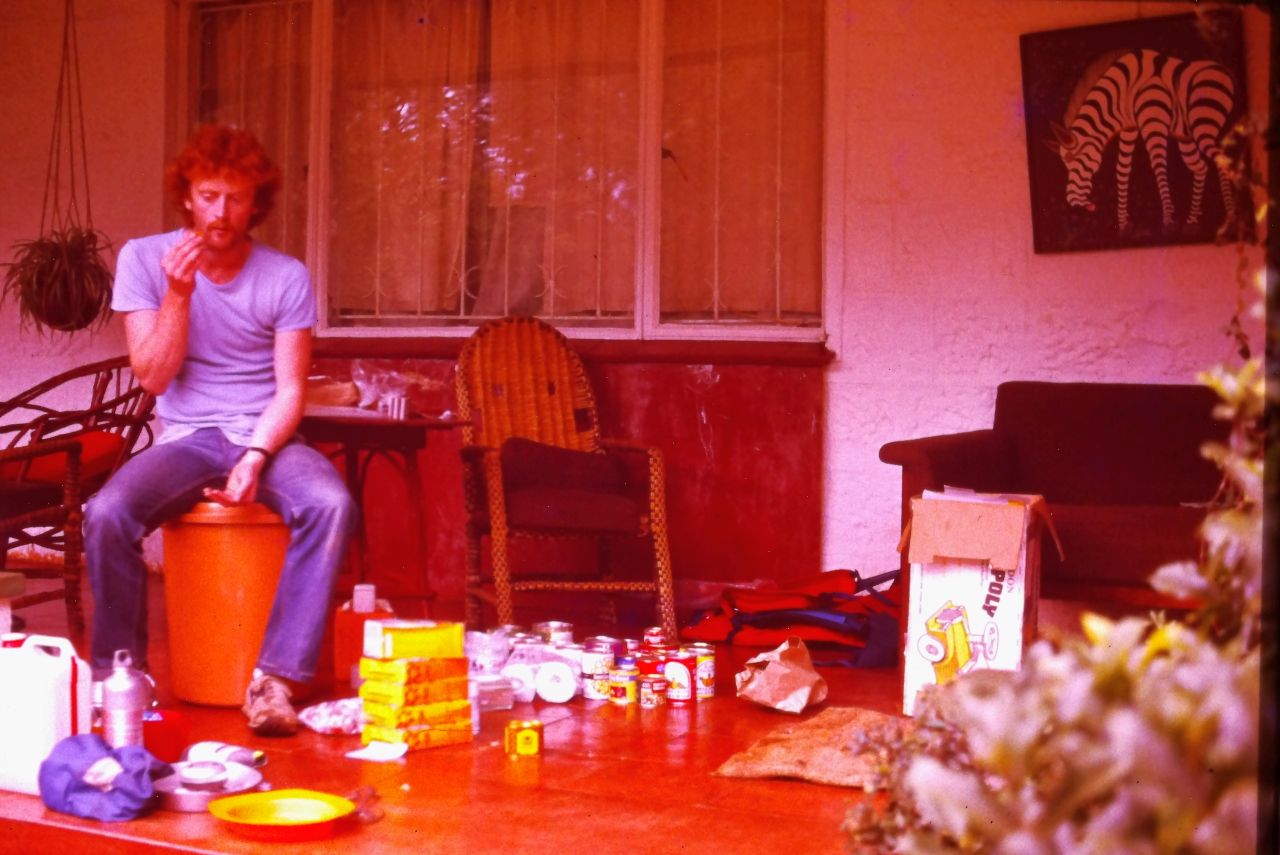
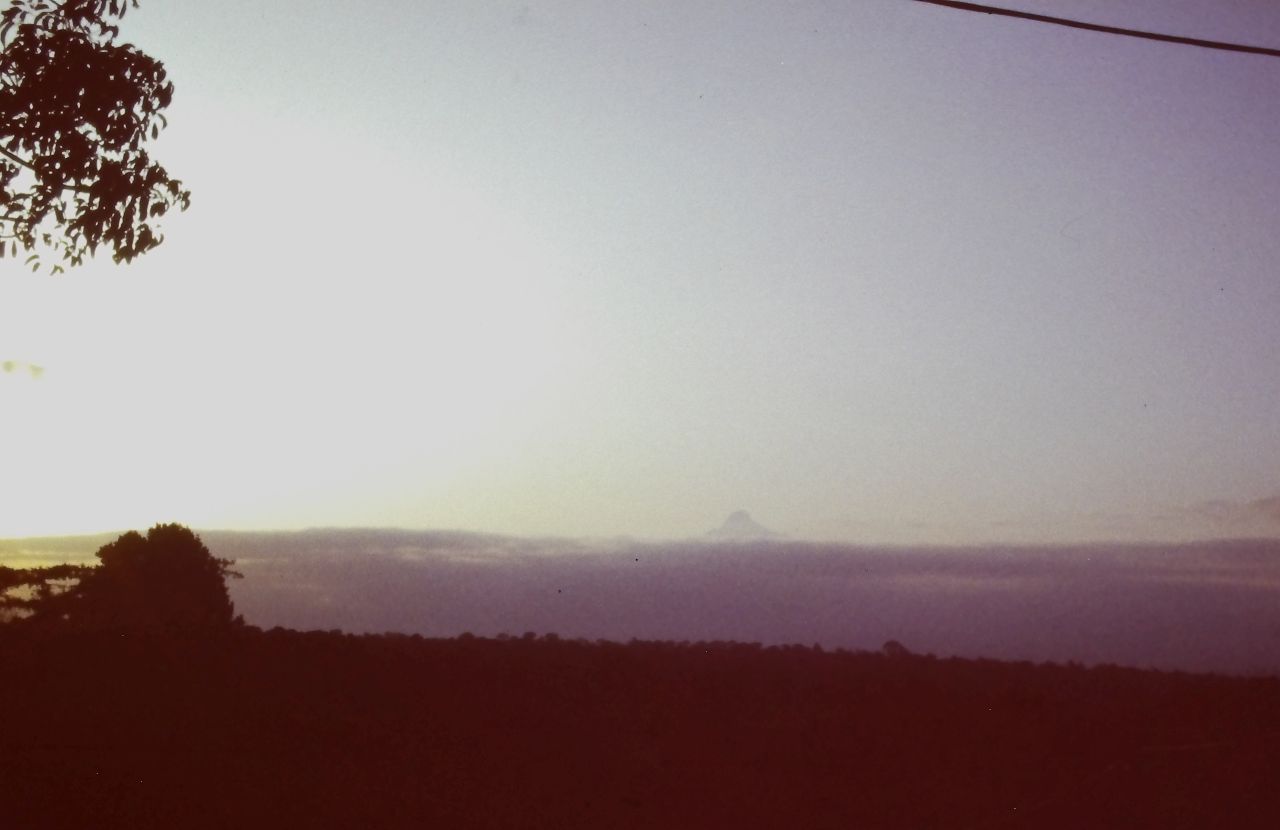
After unbelievable hospitality from Rod and Bar Bennett (Bar being the sister of the once famous Crane twins) on the outskirts of Nairobi, Steve and myself found ourselves at Naro Moru Lodge after an uncomfortably sweaty coach ride northwards. In pretty short order we had arranged a truck ride to the Met Clearing and a group of porters who would help us lug enough grub and gear up the hill for three weeks. The first morning we woke up and crawled out of our tent at the Lodge, it took a few minutes to realise that we were looking at Mt Kenya. Instead of the jagged soaring peaks, what confronted us was a huge, broad, gently sloping shield rising to an improbable tiny nipple of blended rocky spires, that looked almost ridiculously tiny, through the haze.
Onto the Big Hill
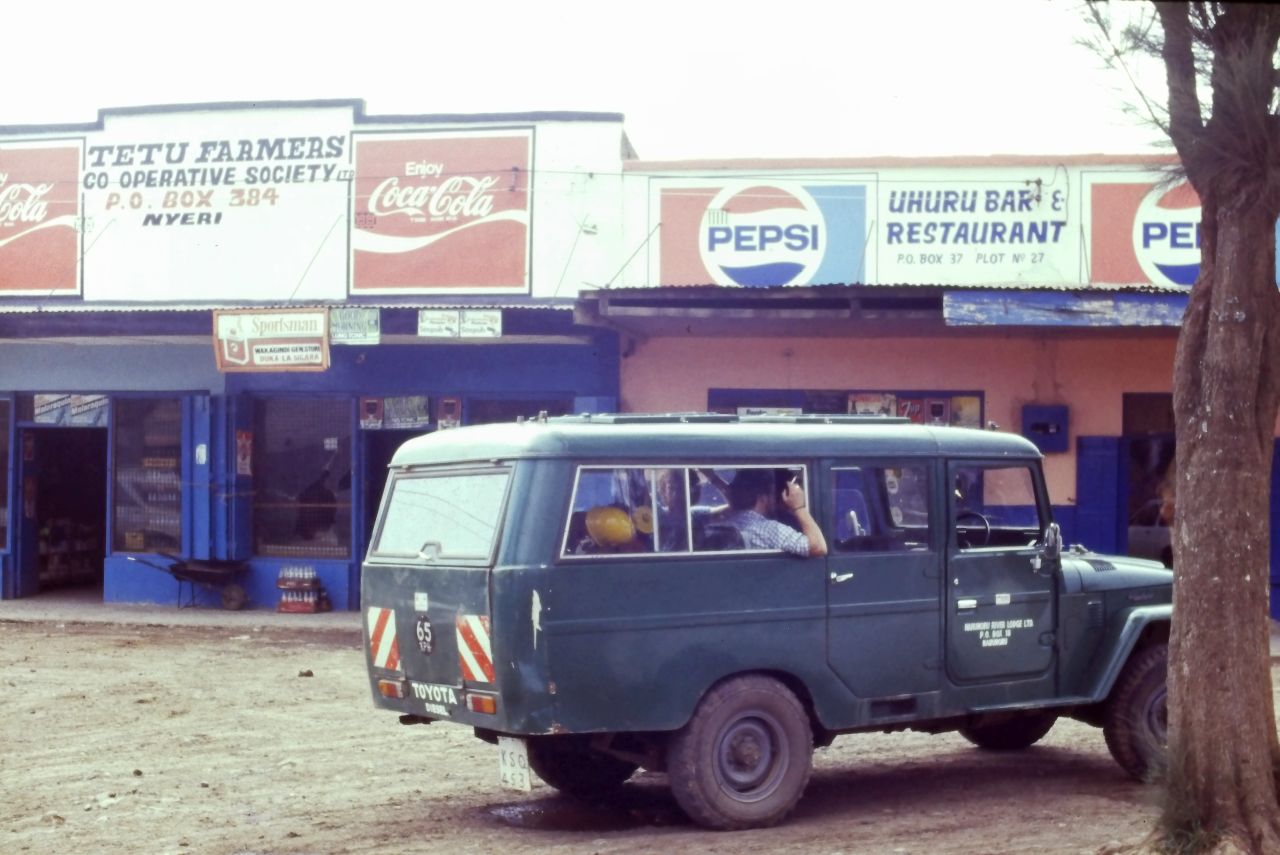
Soon enough we were bumping our way up the Naro Moru trail in a dusty Toyota, sharing the cost with a Swiss couple, Angela and Peter. Our porters: Samor, Christopher and Robert travelled with us, on our way to the equatorial altitude sickness capital – the infamous Met Clearing at 10,000 feet altitude. I was already gasping a wee bit as we set up the tent for the night and began sorting out the gear and food.

At 5am we were up and sorting kit into final porter loads. We set off at 6:45 with those 3 strong lads carrying the bulk of our kit… and soon leaving us for dust. At 5am we were up and sorting kit into final porter loads. We set off at 6:45 with those 3 strong lads carrying the bulk of our kit… and soon leaving us for dust. We were about half way to McKinders camp when the four came zooming back down the path having already deposited our kit at the camp. Tips were dished out and the lads were gone in a flash. Comfortably and totally acclimatised locals who were only interested in earning cash for their families or education.
Steve and I wheezed on out of the jungle and away from the trees, festooned with Old Man’s Beard, and onto the so-called vertical bog… a tropical bog version of the Allt a Mhuillin trail on Ben Nevis (before the paths were built). Eventually we entered the drier zone where the giant groundsels and lobelias dominated. Sun birds drank from leaf trapped water and flowers, while Rock hyraxes scuttled around boulders like marmots. As we wound our way upwards, Steve cruised away ahead of me; taking just 5 hours to reach the day’s destination. I was another hour and a half behind him.
McKinders Camp
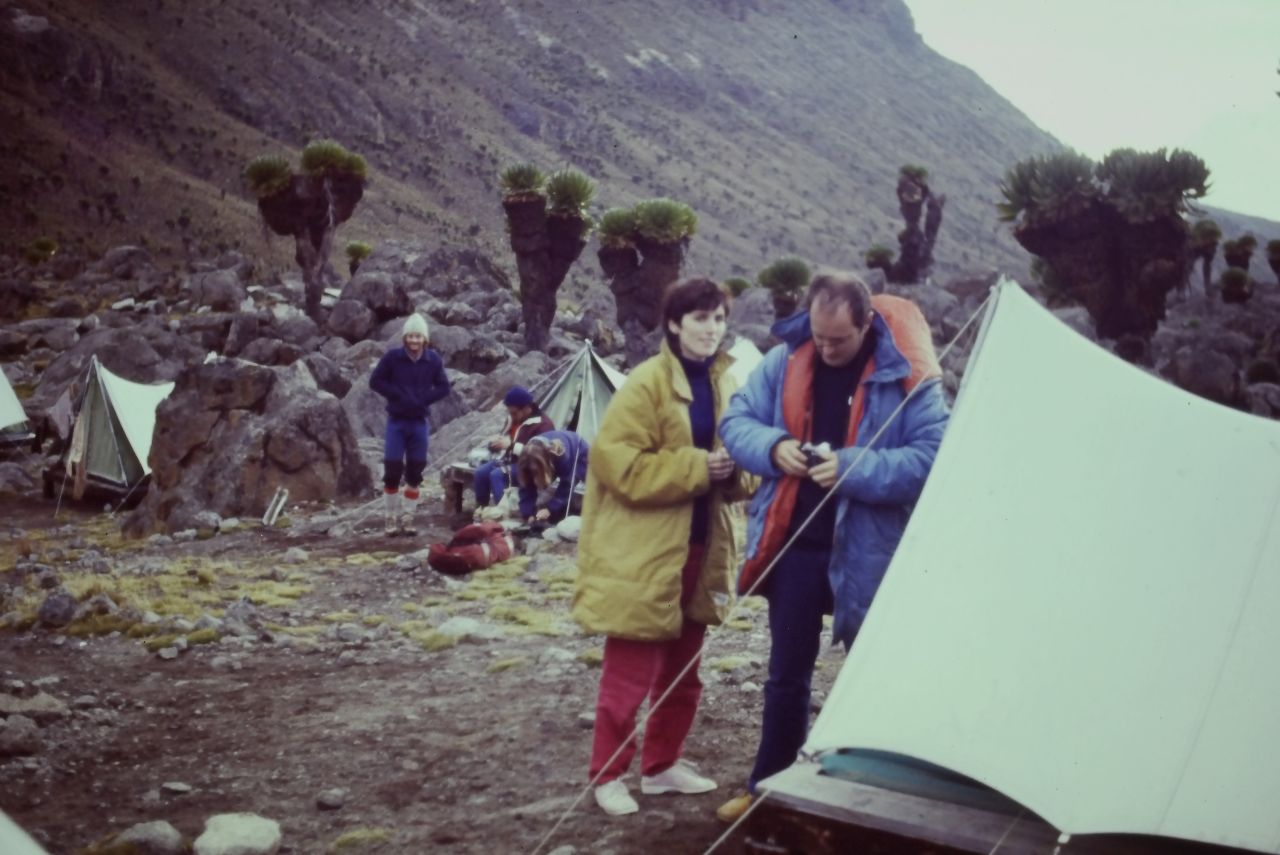
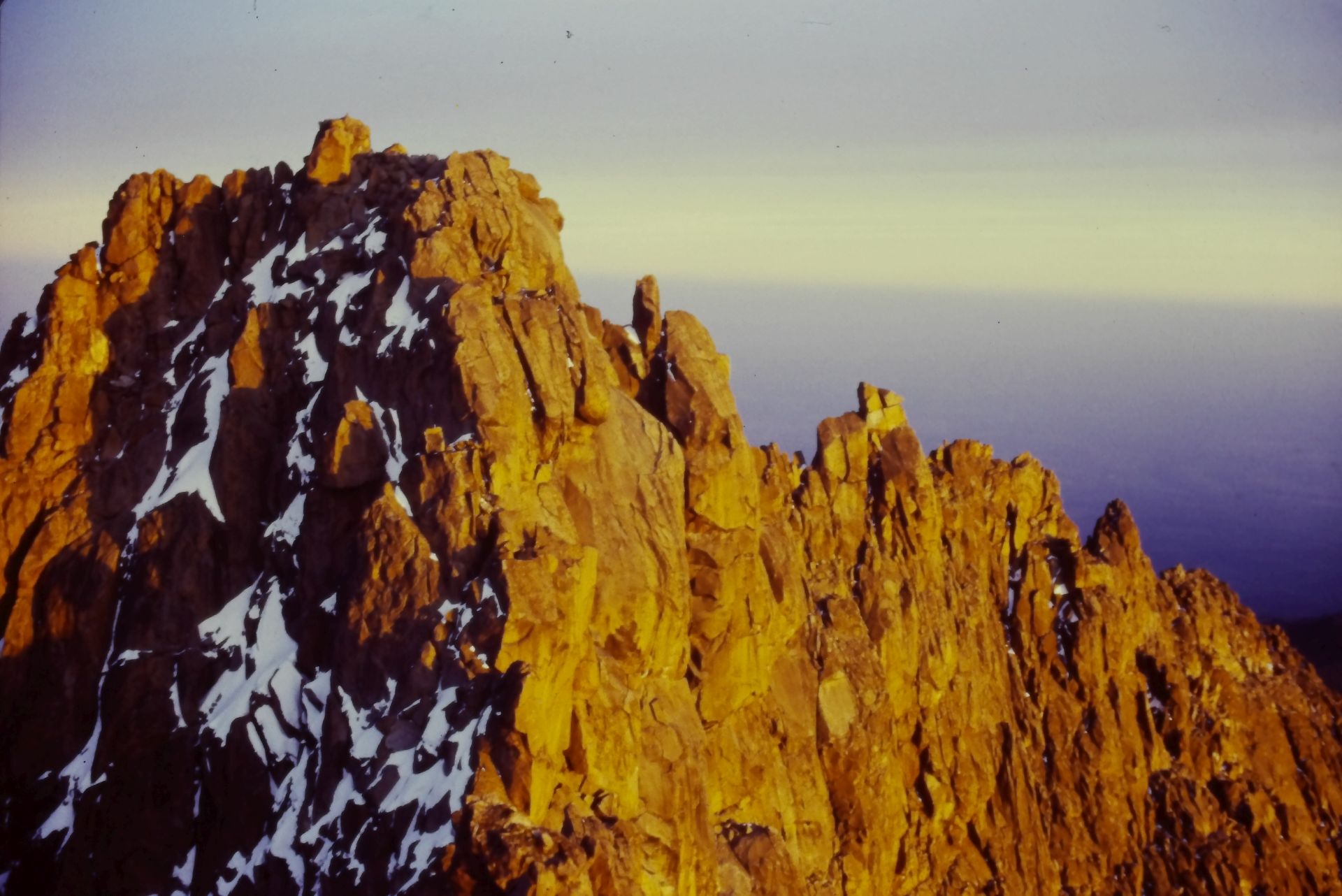
McKinders Camp which sits at about 4300m, was in those days, a collection of tents on platforms. We set up our tent for the night close by, chatting to lots of other visitors who were there to “do Mt Kenya”. For them, that meant walking up Point Lenana, a satellite peak on the opposite side of the Lewis Glacier to the main peaks: still at the substantial altitude of 4,985m. Our plans were for gnarlier, more “manly” things 🫣 and there, towering right in front of us, were the (now not so tiny) rocky spires of Midget Peak and Point John, with Batiaan and Nelion, cleft by the Diamond Couloir.
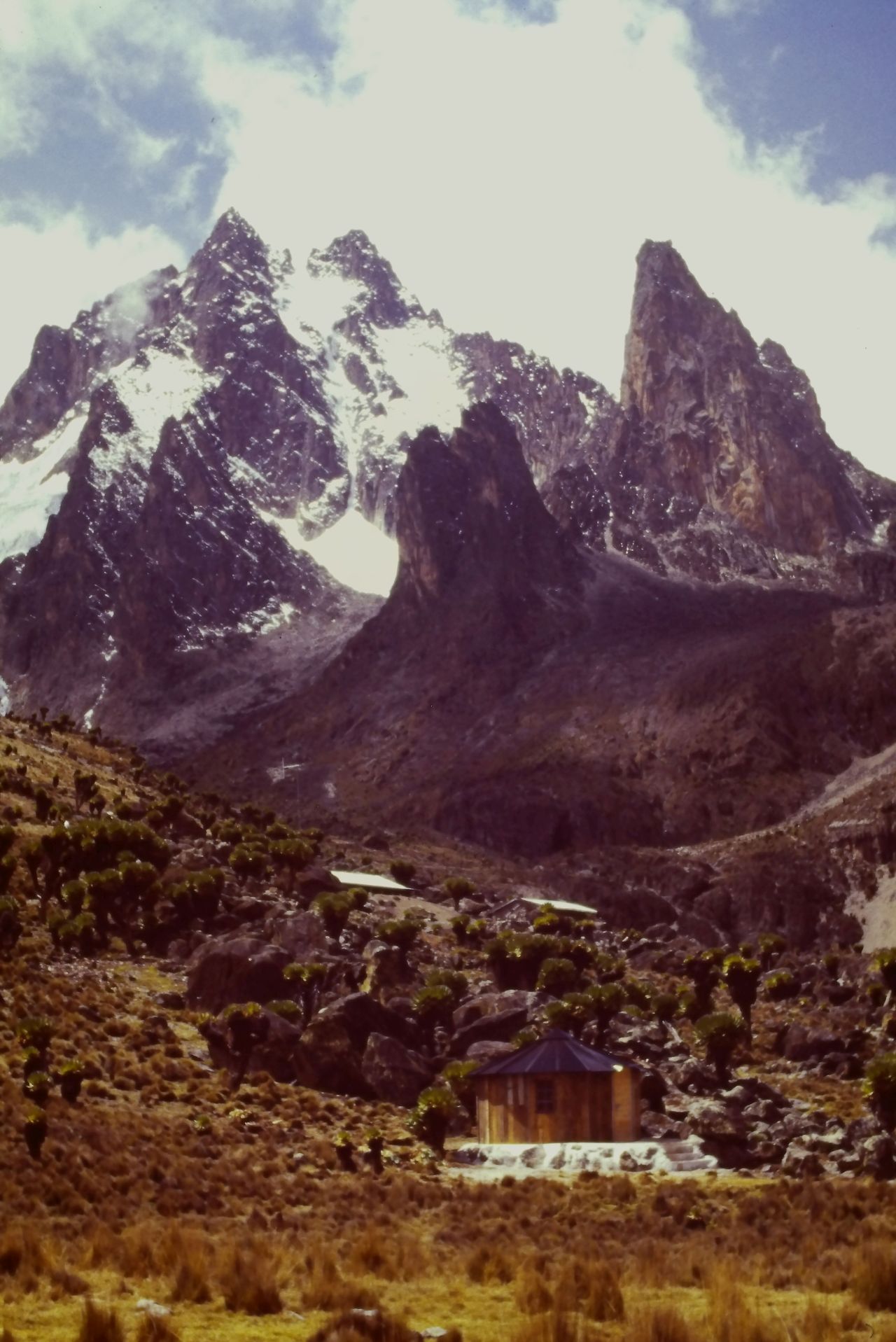
Midget Peak didn’t look so tiny any more and Point John looked incredibly impressive. However, at that point, my legs were so sore and my brain so overwhelmed by the sight of our objective up close, I didn’t manage to get any real sleep that night.
Building a Basecamp
Next day our own “donkey work” began. A late start saw us get to work shifting about 120kg of stuff up to the site of our base at “American camp”, a flattish spot about a hundred metres higher up and a mile or so away. It’s nearer the foot of the more wintery south side of the main peaks that we were interested in. We managed 2 heavily laden ferry trips carrying our big plastic bin (“Mouse proof” foodstore) and all the tinned food to a stash under a big boulder. Then it was a slightly less painful descent to McKinders to settle down for a rather headachey night. Acclimatisation to the 12,000+ ft altitude was clearly going to be slow!
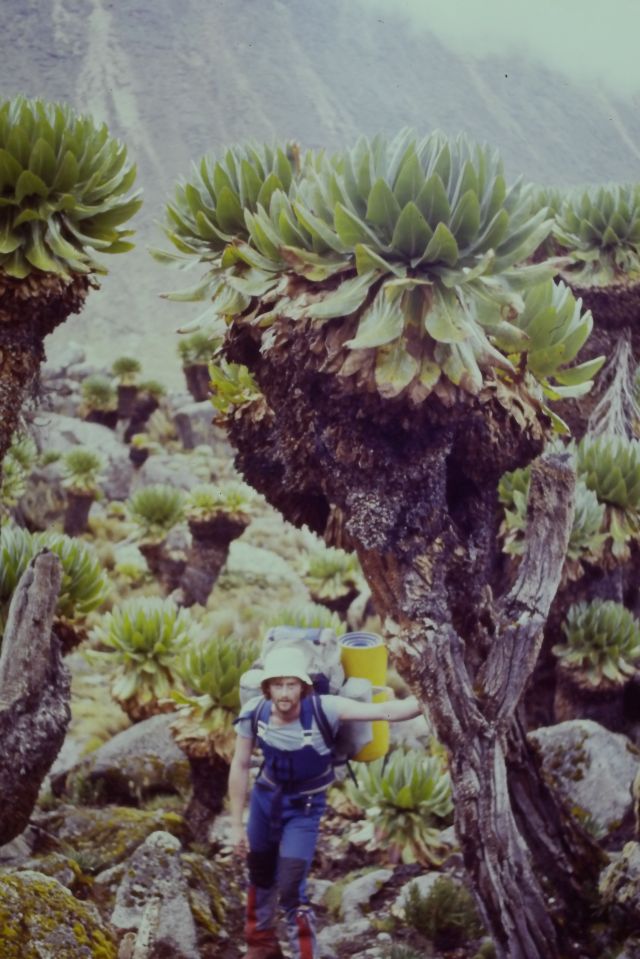
A second day of burden saw us change our minds about the siting of the tent and we managed to find a slightly less swampy spot. Some heavy sleet and snow in the afternoon reminded us of the title of the book: “No Picnic on Mt Kenya”.
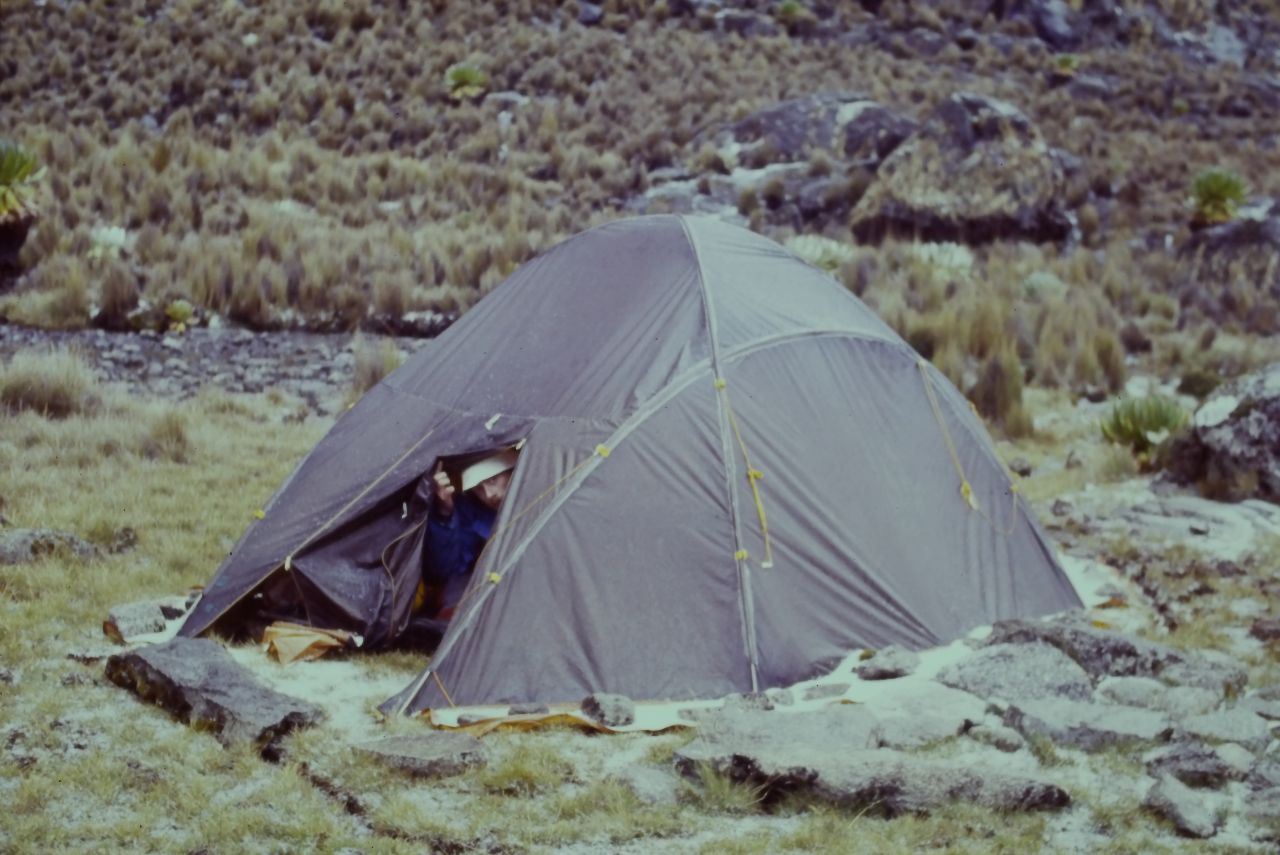
Point Lenana: the Trekker’s Mt. Kenya Summit
Next day we decided to head for Lenana via the Lewis Glacier itself. Just a wee stroll… with a 4am start! On the crest of the glacier, beneath the towering rock walls of Pt. John and Nelion, we met an extremely cold wind as we traversed a minor ridge towards Lenana’s surprisingly rugged peak.

Soon enough we reached the rockier ground of the summit and the junction with the tourist path. A short final scramble saw us looking out to superb views. To the east over the Gorges Valley. To the north, the iconic looking Terere and Sendeyo peaks, while closer at hand the vast rocky faces of Point John and Nelion still loomed. Westwards and down, the still substantial Lewis glacier (back in 1983) the eye was drawn to Mackinders and the Naro Moru valley.
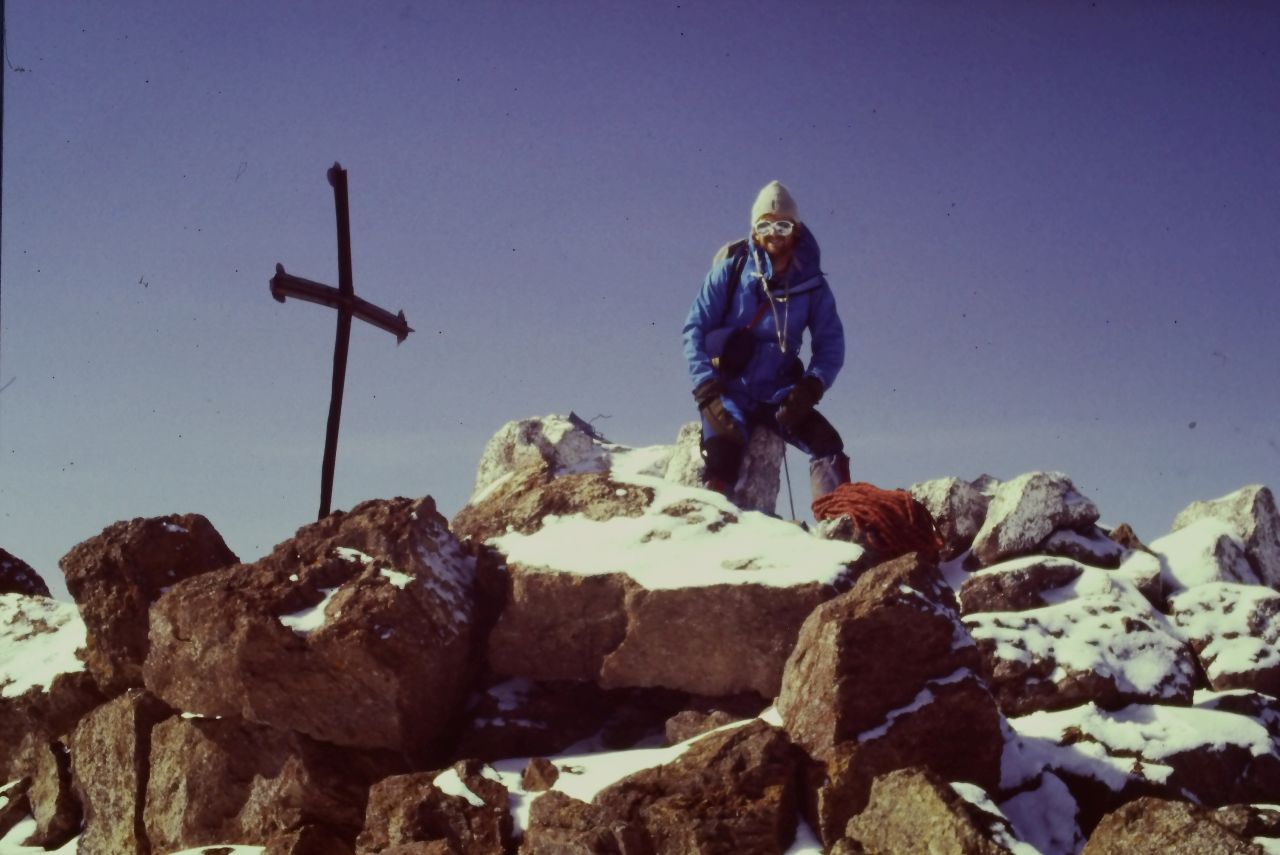
As we wandered back down we passed the Austrian hut and several trekkers still on their own Lenana ascents and descents. By the time we arrived back at the tents our heads were exploding. I still can’t recall a headache like that even after alcohol abuse! It took two full pint mugs of tea to bring relief. Altitude and dehydration were really making themselves felt. Remarkably, after a couple of hours we felt rested enough to take a wander up to look at Hut Tarn to round off the day.
Next day, July 31st, after a very windy but slightly less frosty night, was basically rest and prep! First thing the following morning, movement on the face caught our eye and we saw a couple of MCK (Mountain Club of Kenya) lads, who we’d spoken to at Mckinders, on the Ice Window route.
The Real Thing at Last
We sorted out our winter climbing gear, bivvy kit, food and stove, for an attempt on the Ice Window ourselves, as a warm up for the Diamond. As we were beavering away, a couple more English lads turned up, Colin and Bruce from Cambridge, if memory serves me right. After a good bit of craic with the new arrivals, we set off for the bivvy under the boulders beneath the Tyndall Glacier.
As usual Steve got there way ahead of me, but by 5pm we were getting sorted and spying out the way up to the start of tomorrow’s climb. The setting was incredible… a frigid alpine setting with ice choked couloirs and faces soaring upwards, exactly 10.3 miles south of the equator! It still didn’t seem real!
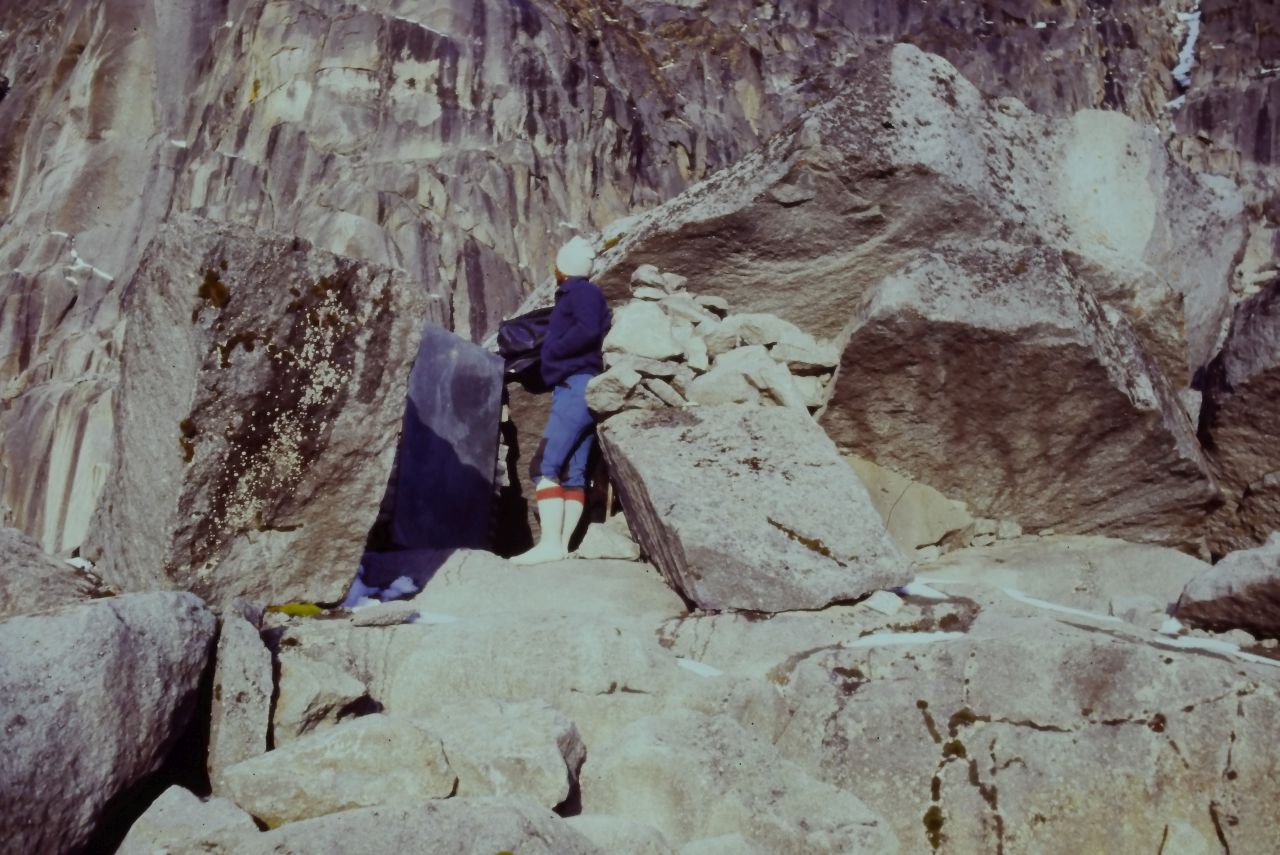
A later start than planned, after another slightly sleepless night, saw us flogging up the glacier around 6am.
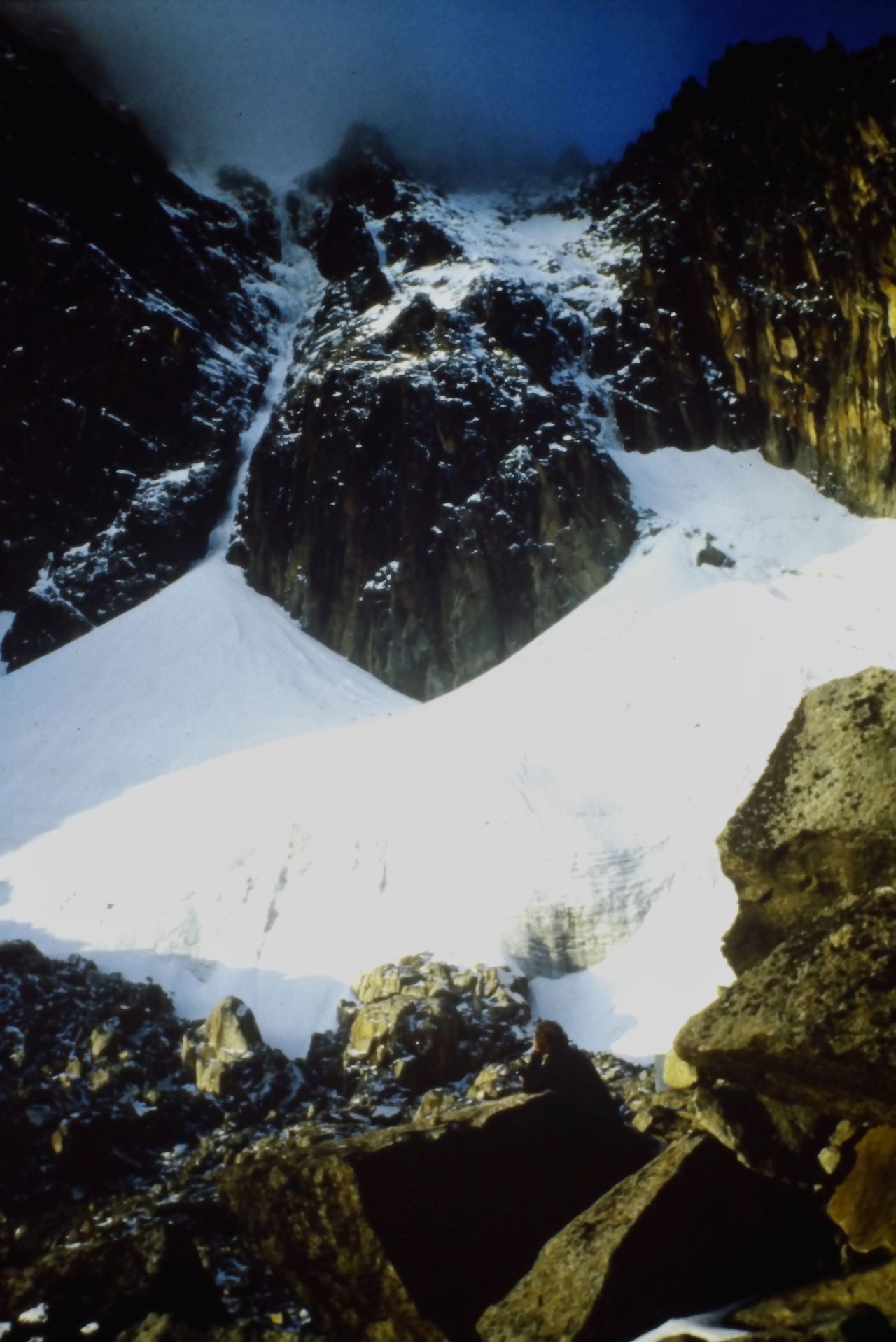
From the start of the route we could see the way lay up a series of slabby rock buttresses, with a steeper pitch to start which I think Steve led. The next section was about 250ft of easier angled slabby scrambling where we moved together. At one point I needed to take off my brand new, pristine, white goretex overmitts to sort some gear out, only to see one of my prized possessions flutter away downwards to disappear into the white of the glacier 3 or 4 hundred feet below.
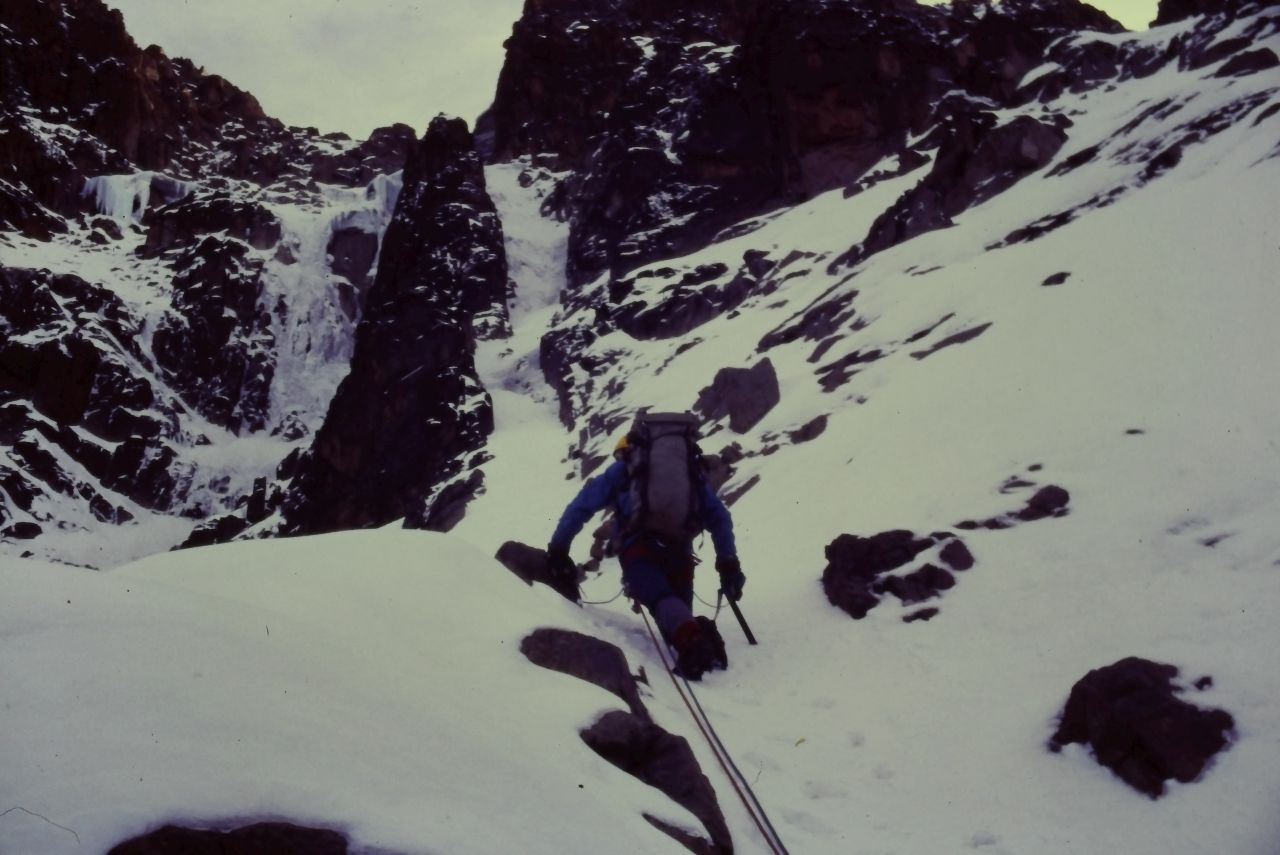
The slabs took us to the meat of the route: a very Scottish looking gully. It was lovely steady climbing with one steepish pitch. After about 4 or 5 pitches the gully fizzled out into the steeper ground of the upper face. The line then went for a big traverse pitch leftwards above the Diamond Couloir. Easy climbing, but very exposed feeling, and I don’t remember much in the way of gear either, it felt slightly precarious.
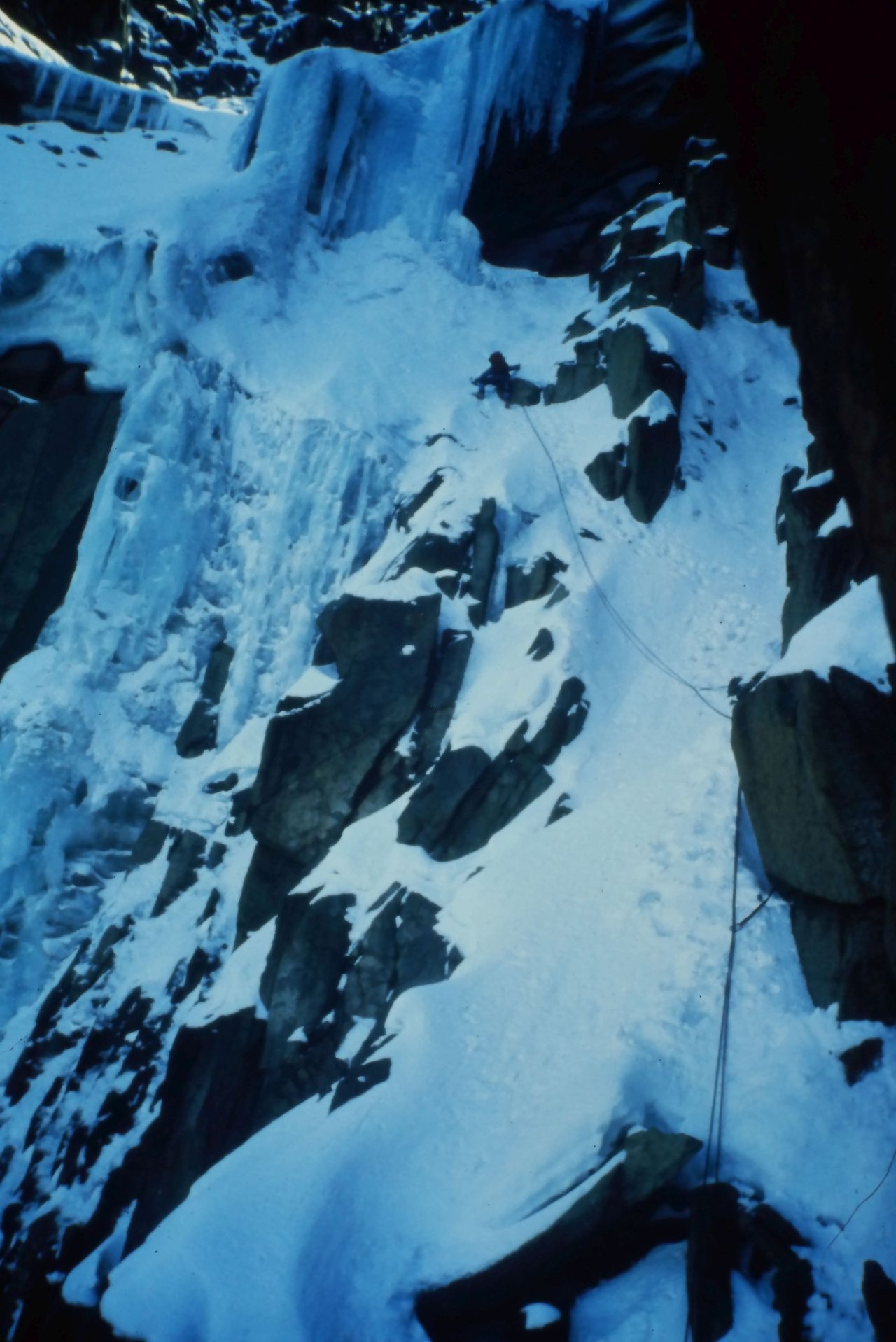
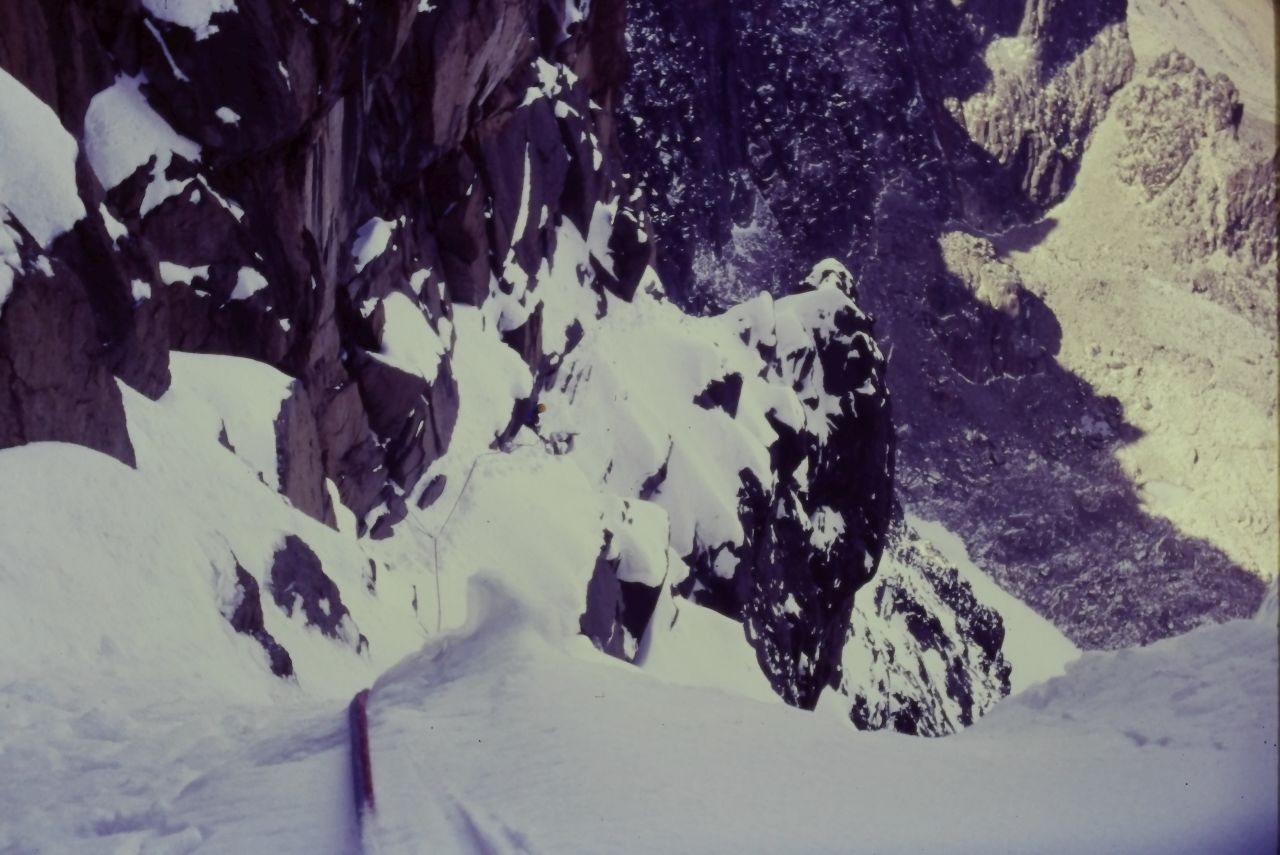
After a nervous teeter, I arrived under the lip of the Diamond Glacier itself. Belaying quickly, I soon had Steve across and we couldn’t believe the “palace” we’d entered.
A Window In The Ice
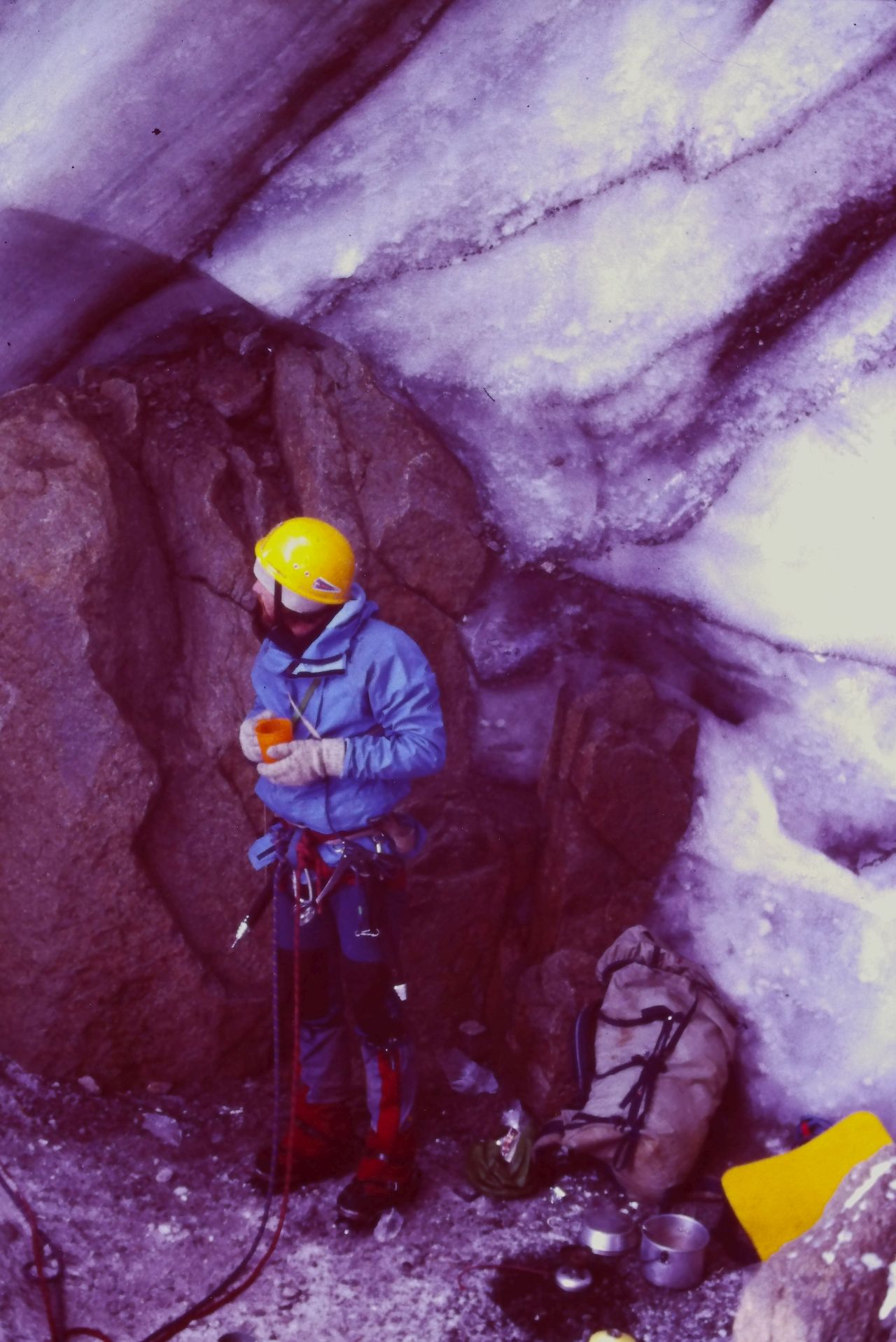
A 20 foot high back wall of ice, that curved over our heads to roof us in and a front wall of translucent icicles, metres thick in places, provided a well described shelter (in the guidebooks and accounts we’d read) but an unexpected feature was the almost perfectly flat rock ledge floor! It was the perfect spot for a breather and a brew.
Now, the guidebooks described the route as progressing by smashing a hole through the icicles and climbing out onto the front face of the icicle screen, to progress up onto the easier angled glacier above. I was somewhat relieved to hand the lead over to Steve. Fortunately the hard work had already been done a couple of days previously by the MCK pair and the hole had not resealed itself.
Tea drunk and stove packed away, we both ambled over to the hole and looked out. The icicles were just the very top tier of the Diamond Couloir’s headwall, which dropped giddily away from us into the depths we hoped to be climbing in a few days. Further out we could just distinguish our tent and the other pair’s at American Camp. The conditions were absolutely perfect, bright,cold and calm.
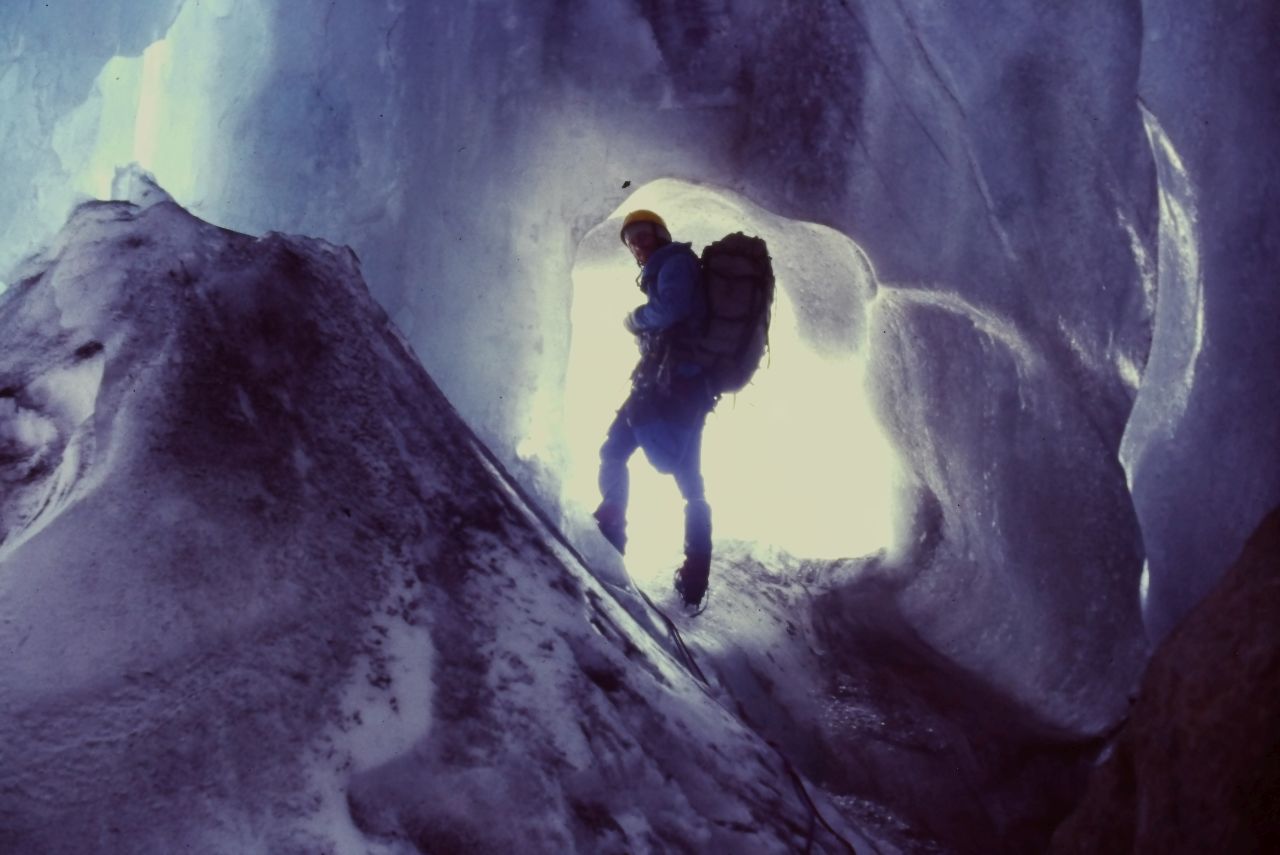
A screw in the ice at the back secured me while Steve pondered how to get established on the outside, without an unscheduled inspection of the Diamond! Axes on both inside and outside seemed to be the solution. I think he shouted in that it only looked like another 20 feet or so to get up onto the easier angled part of the Diamond glacier. And then he was gone… upwards fortunately.
On a day like that, it was hard to imagine how the Diamond had such a fearsome reputation from when it was first visited and was seen as a bit of a death trap. Clearly the lip of the hanging glacier had already receded substantially in the nearly 3 decades since the notorious ice collapse which had killed 3 British lads on leave from Aden in 1964. Glacial recession was clearly already well under way. It wasn’t long before some vague noise and a bit of rope tugging told me it was time to set off for my own Ice Window experience. It really was something else to lurch through the hole get 2 good “sticks” in the ice above and step out onto the vertiginous headwall.
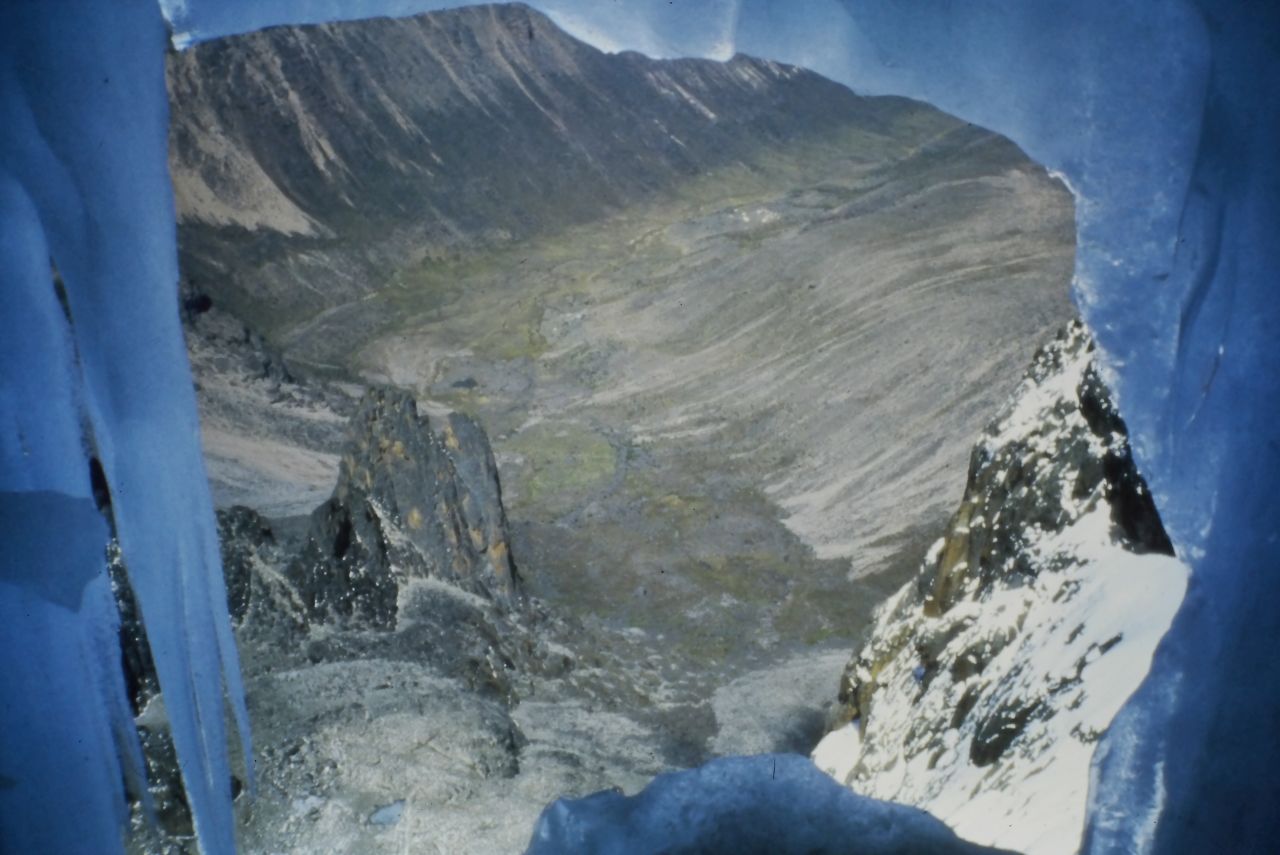
Looking straight down between my feet and down the length of the Diamond was dizzying. Even more ridiculously, 10 or a dozen moves had me up onto the 50 degree ice of the glacier above, in sight of Steve, and beyond him the Gate of the Mists. Completely mad… 10 miles from the equator and we were tap tapping up glacier ice! 3 more long dreary pitches on steadily deteriorating ice, in the afternoon sun, saw us up and into the Gates: the hard icy saddle between Batiaan on the left and Nelion on the right.
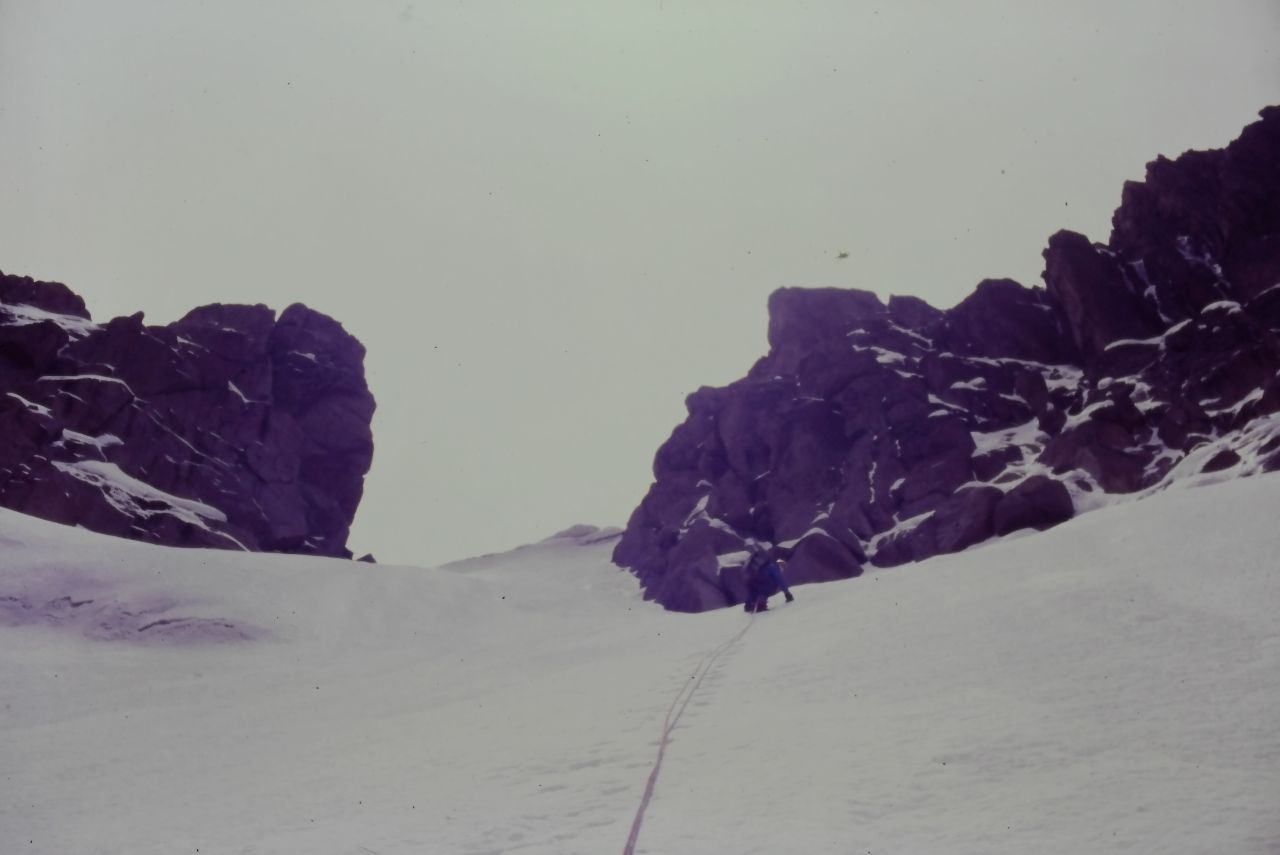
Legs knackered, arms drooping from the constant whacking of axes; exiting the Gates wasn’t quite as straightforward as I’d anticipated. So, we had to deal with one more bit of mixed ground before we could take off crampons, untie and scramble to the top of Nelion at around 2pm.
Bivvy Coffins and Darklight
Off to our left we could see and hear French sounding voices on the North Face Standard route as they prepped for a bivvy some 200m from the summit of Batiaan.
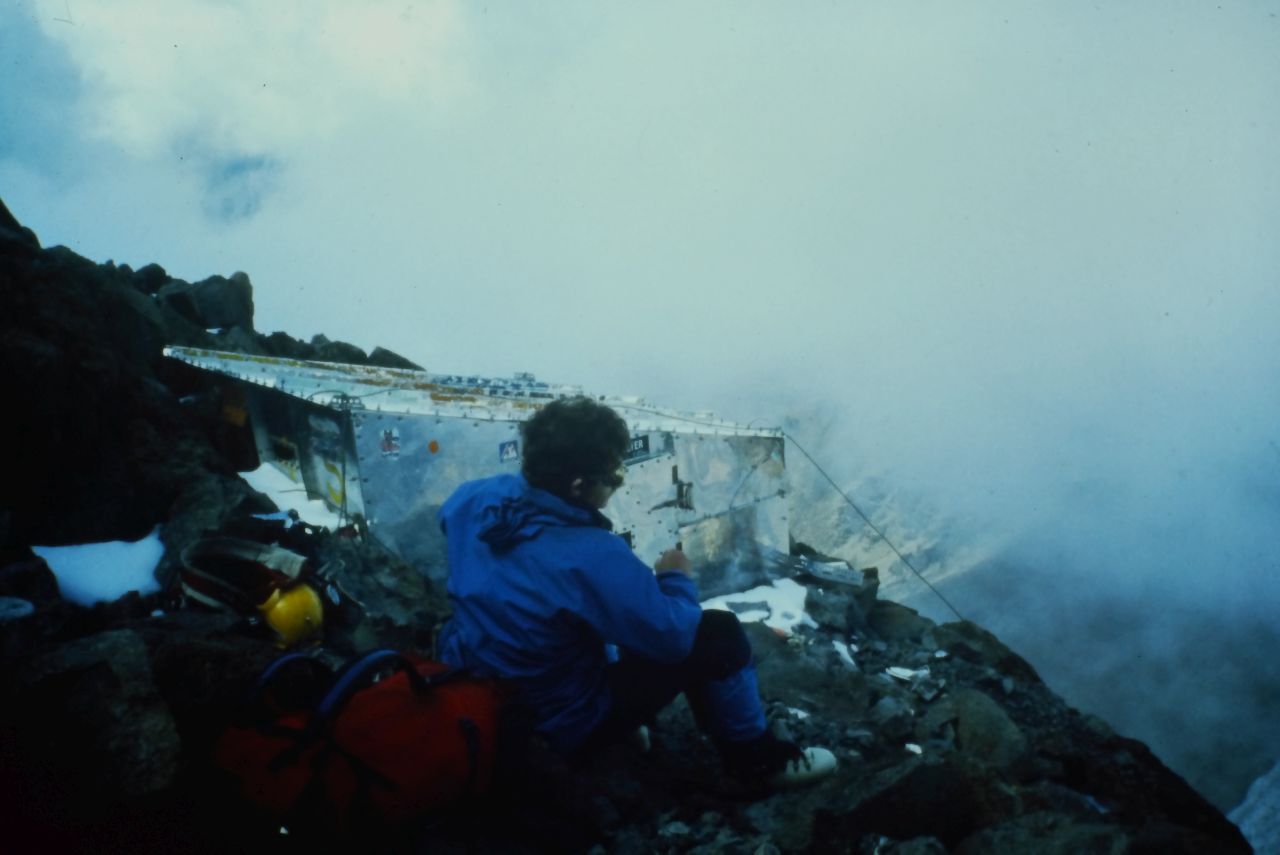
On the summit of Nelion is a shelter which was built almost entirely solo, by Iain Howell, one of the most active members of the MCK back in 1970. He prototyped it in his garden then persuaded the Police Airwing to parachute it onto the Lewis Glacier in five separate loads. He then spent almost a month soloing the standard route up Nelion 13 times “with a pack on his back”! Except this pack was lumps of metal, bolts and polystyrene insulation! What an absolute hero.
After a half hour sitting in the calm sunshine we crawled into this outsized, insulated coffin. We were both well and truly goosed! I don’t think we spoke more than a few words until we decided it was time for some grub. No dehydrated muck for us… this was full weight, vacuum sealed lamb curry! Not much has ever tasted so good! (Apart from the enormous orange at the bottom of Sound of Silence on Sardinia, in 2018 after myself and John Wilson ran out of water on the route).
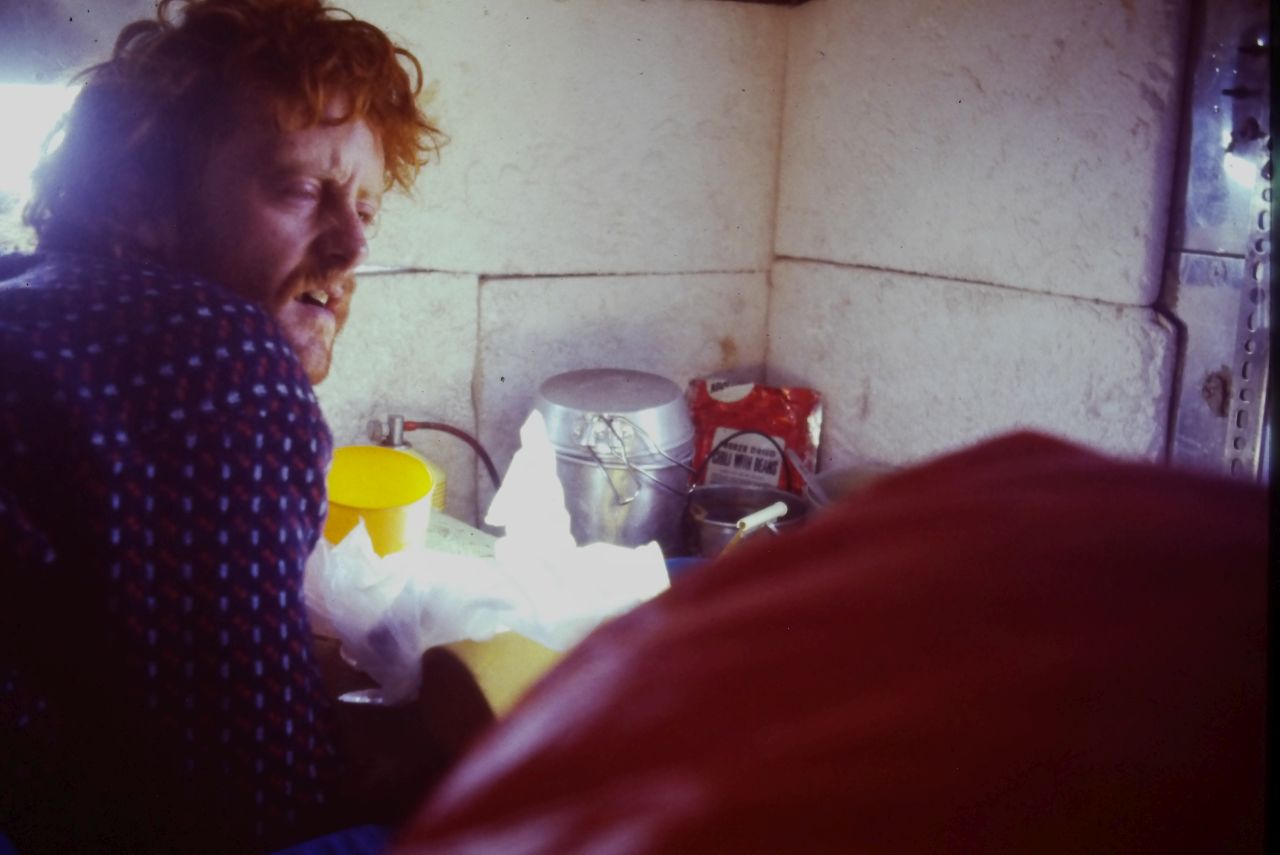
Darkness came suddenly as we sat back outside to soak up the sunset, slightly hidden by thunderstorms over towards lake Victoria, Uganda and Tanzania, and with it the cold. Scuttling back inside, sleep came remarkably easily, acclimatisation had definitely arrived!
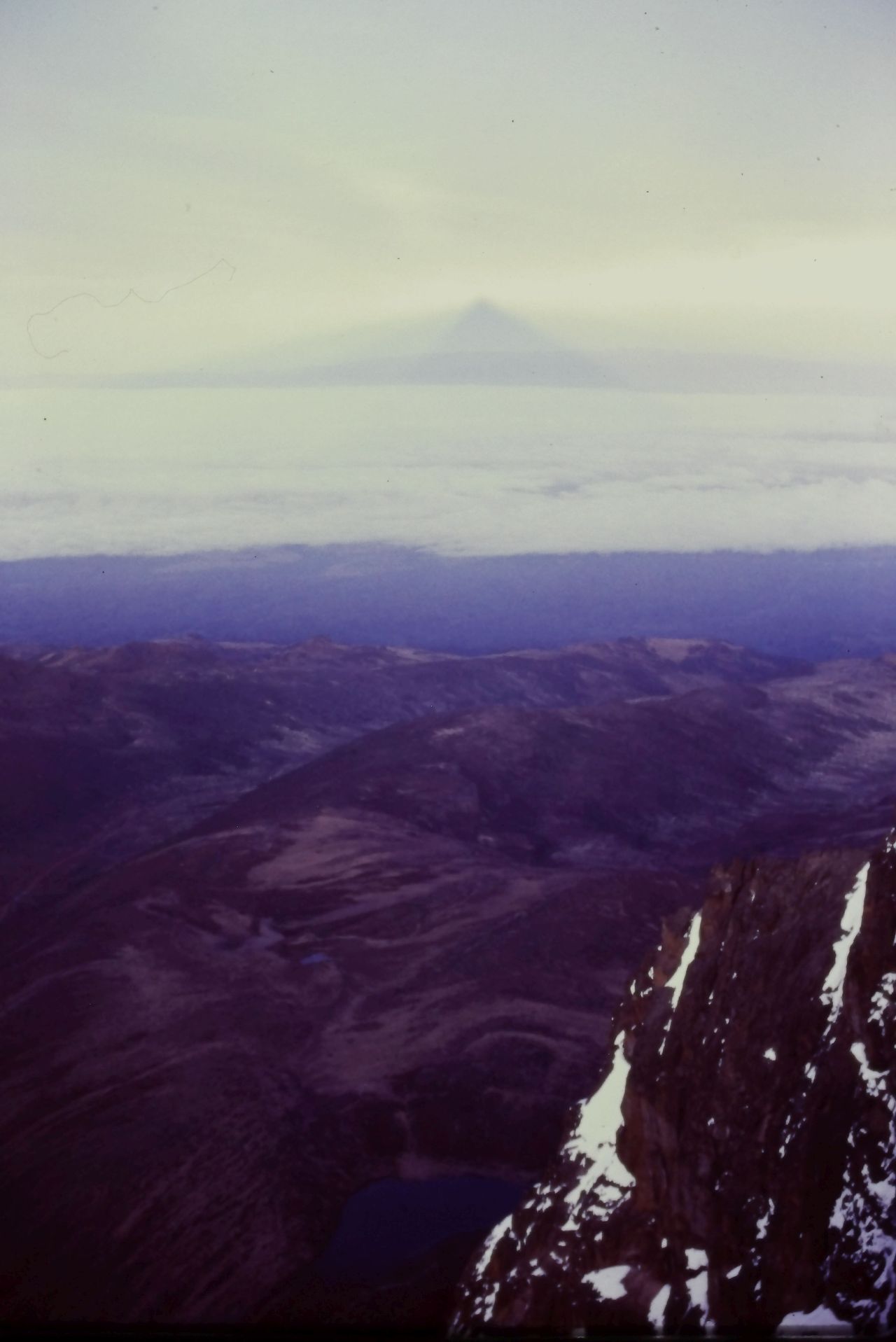
It was time to move. We packed up and Steve quickly found the start of the abseils that led down the normal rock route up Nelion. Amazingly – given my somewhat clueless descent navigation brain – we found our way down onto the Lewis glacier without too much trouble.
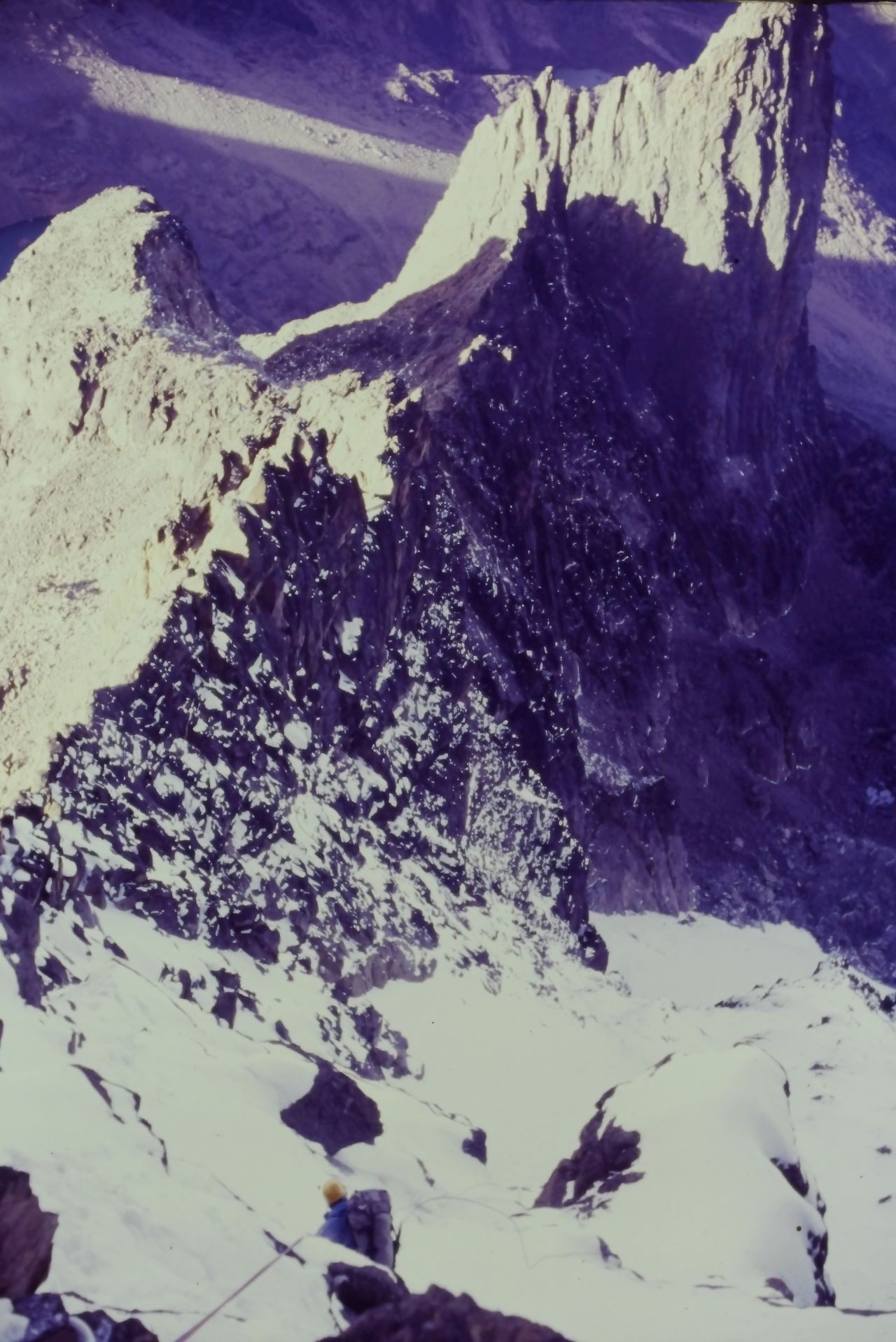
Once on the ice we felt pretty knackered! In my case dragging myself back to American Camp was a relief. The Cambridge lads were still there having been for an acclimatisation ascent of Lenana. The tea they offered up was nectar!
Steve and myself both had a good dunk and wash down in the stream which was pretty warm, but still refreshing on this absolutely glorious day. Bruce took it on himself to wander up to the rock bivvy to have a look, after we piqued his interest and he retrieved our empty water bottles, saving us an extra stroll. I asked if he’d found my overmitt… no joy.
Originally we were going to rest the next day, but Steve suggested we get sorted to tackle the Diamond the next day, by heading up to the bivvy again that afternoon. As usual, I was easily led! Bruce and Colin had already departed for Top / Austrian Hut as they were planning to climb the standard route up to Nelion.
As we were just beginning to sort our gear we became aware of shouting from the big cairn that overlooks American camp – marking one of the paths up onto the Lewis. We eventually realised he was shouting something about crampons. Looking at my sack I saw – there was only 1 crampon! Oh shit! I set off up the path we had descended the day before and by the time I got up to the cairn about half an hour later, Bruce was long gone. There – was a Footfang: perched on the cairn! What a flipping relief. There would have been no Diamond attempt without that piece of kit.
Diamond Geezers
Back down at the tent we cooked up a monster spaghetti bolognese, which Steve couldn’t quite finish. Once we were cleaned up, it was off to the bivvy around 4:30pm. I felt really nauseous and rubber legged this time round. “Over spaghettied” I think! Once we arrived at the bivvy boulders, I went up a bit higher to where I thought the fall line from the Ice Window’s entry slabs would be. Sadly there was no sign of the dropped overmitt; which scared me a little bit because I only had Dachstein mitts and a pair of thinnies, in those days. The fear of potential frostbite at that 16 – 17k feet altitude was real.
Diamond Couloir Geezers
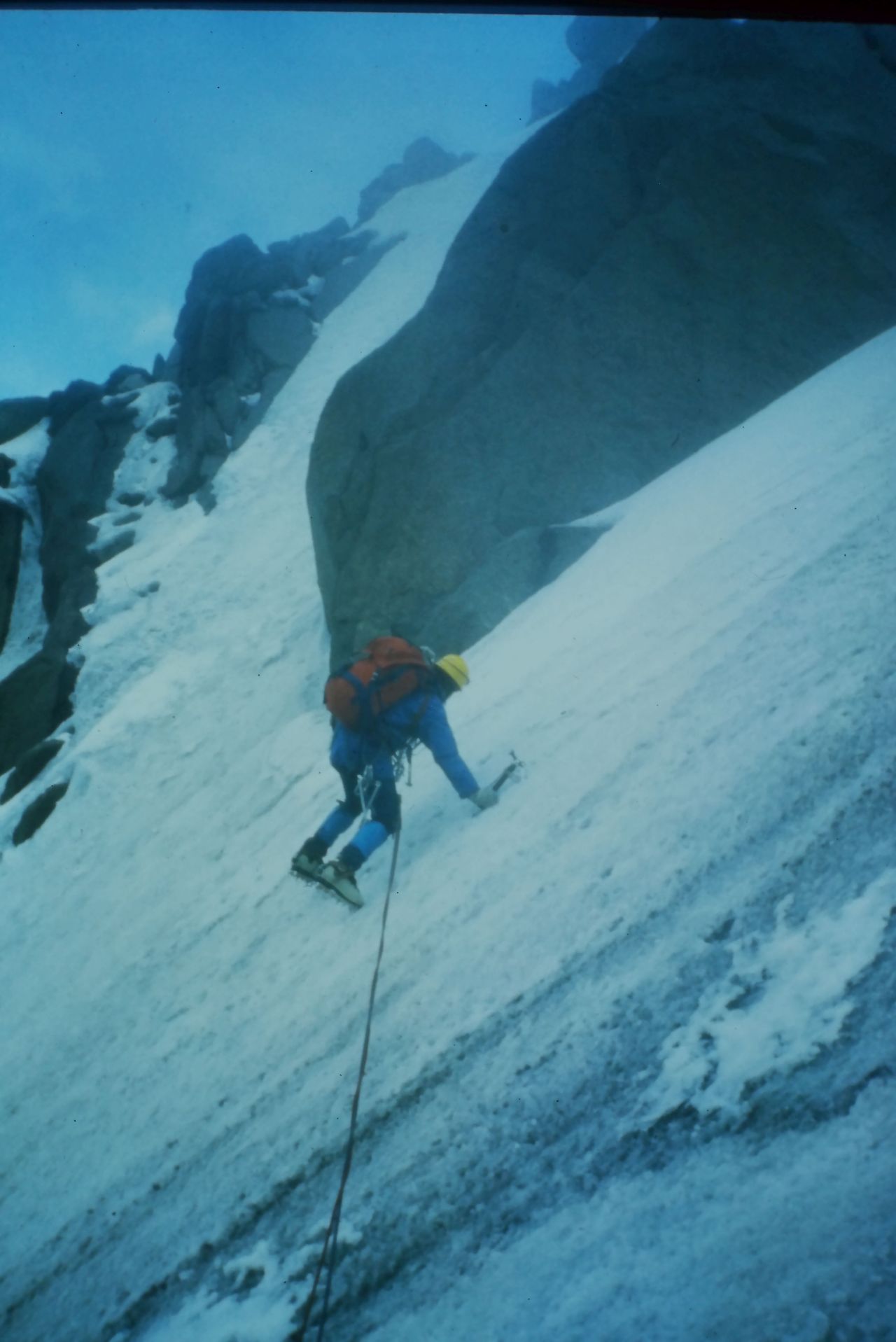
After a fitful nights sleep, probably due to being bloated, we were both awake at 4am in the dark. We were very sluggish to get going and only got to the bottom of the couloir at 7. I looked up at this immense sheet of ice that forms the entry pitch and just thought. “What the hell have I let myself in for here?” It was steep but the ice was fat – like the best Scottish stuff. Steve very graciously offered me the chance to start leading. As I set off up this tropical classic, I never imagined, that by the turn of the century, it would, essentially, be no more. I was able to focus on that painfully joyous rhythm of steep relentless swinging of axes, with rarely the need for a second attempt to get them to stick. And there was the calf crushing grind of kick, stick, keep your heels low. It felt like everything was going brilliantly.
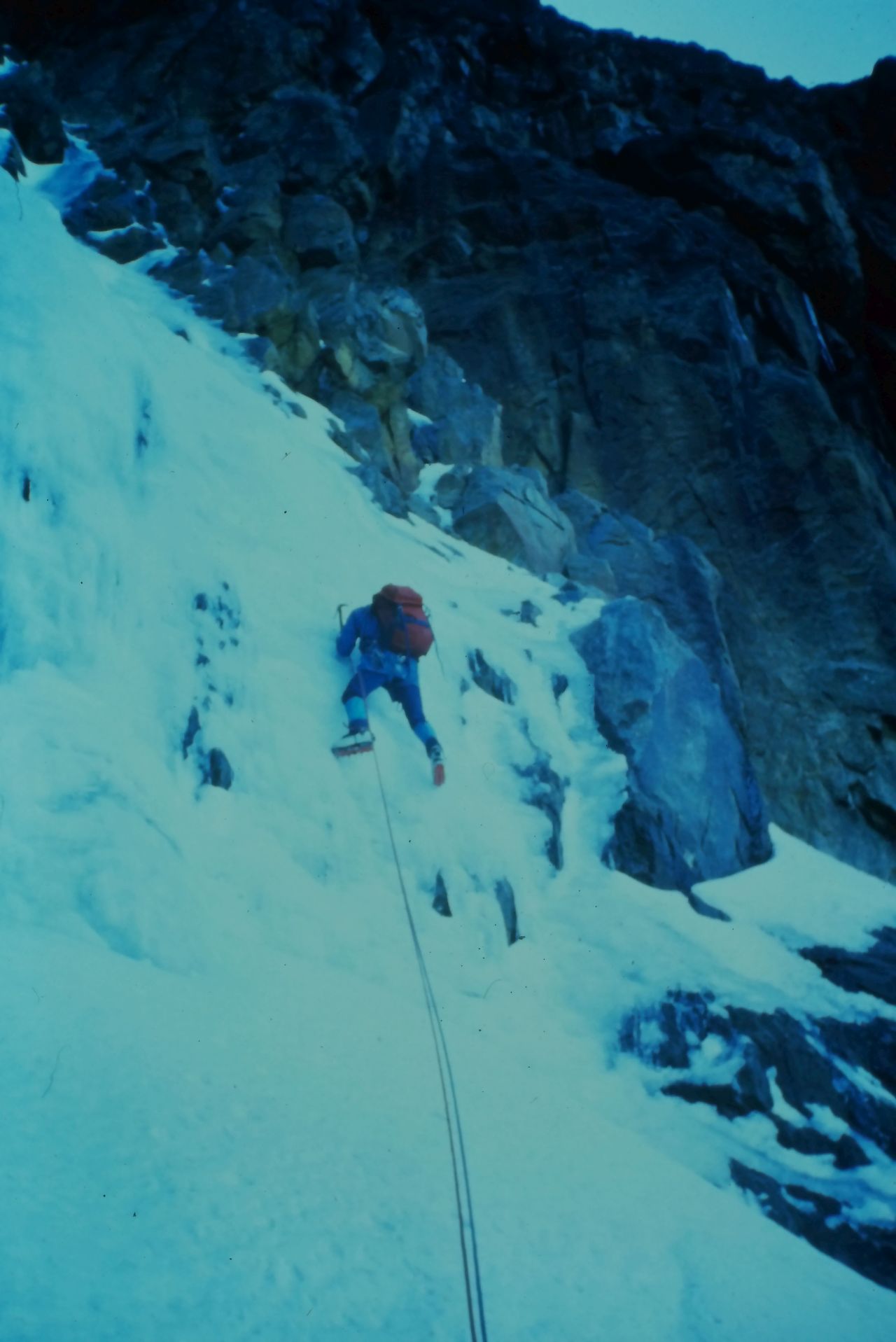
I was about 2 thirds of the way up the pitch, maybe three quarters, when Steve shouted up that I needed to find a belay. We were climbing with 50m X 9mm ropes and I was a good 45m up with probably just three screws in as runners.
This is where incomplete experience finds you out. I’d never set up a belay in the middle of a steep ice pitch before. Everything I’d done, on ice, up to this point: in the Lakes, Scotland or the Alps, had landed me at fairly obvious belay stances.
Panic began to set in a little bit. I scuttled out rightwards to what looked like a potential rock outcrop with peg or nut possibilities, but it was useless. We didn’t have many ice screws in those days and what we had were pretty crap: apart from this one Chouinard beast that had been saved from the Peru trip the year before. I took a deep breath and started trying to wind it in to the ice. It had probably only been used in anger twice before so thankfully it was still sharp and very soon it was biting in. It was nothing like the modern screws we use now, but it was infinitely better than the Snargs which were the rest of my ice rack.
Thankfully it went in for its full 15cm depth. I clipped in, breathed a sigh of relief and battered one of my Snargs in as a second anchor. Finally my calves could relax. I hastily cut out a ledge for my feet – or in reality my crampon edges and prepared to bring Steve up.
I can’t remember who suggested it but we decided that Steve should climb to the first runner, belay again and I would continue leading to the relative sanctuary that appeared to be just a short way above. It was actually a good 20m or more and again the rope only just reached. But there was a rock anchor for the belay! When Steve got up to me, we reckoned that the pitch was probably a full 180 – 200 feet in height. Something we hadn’t fully appreciated before setting off.
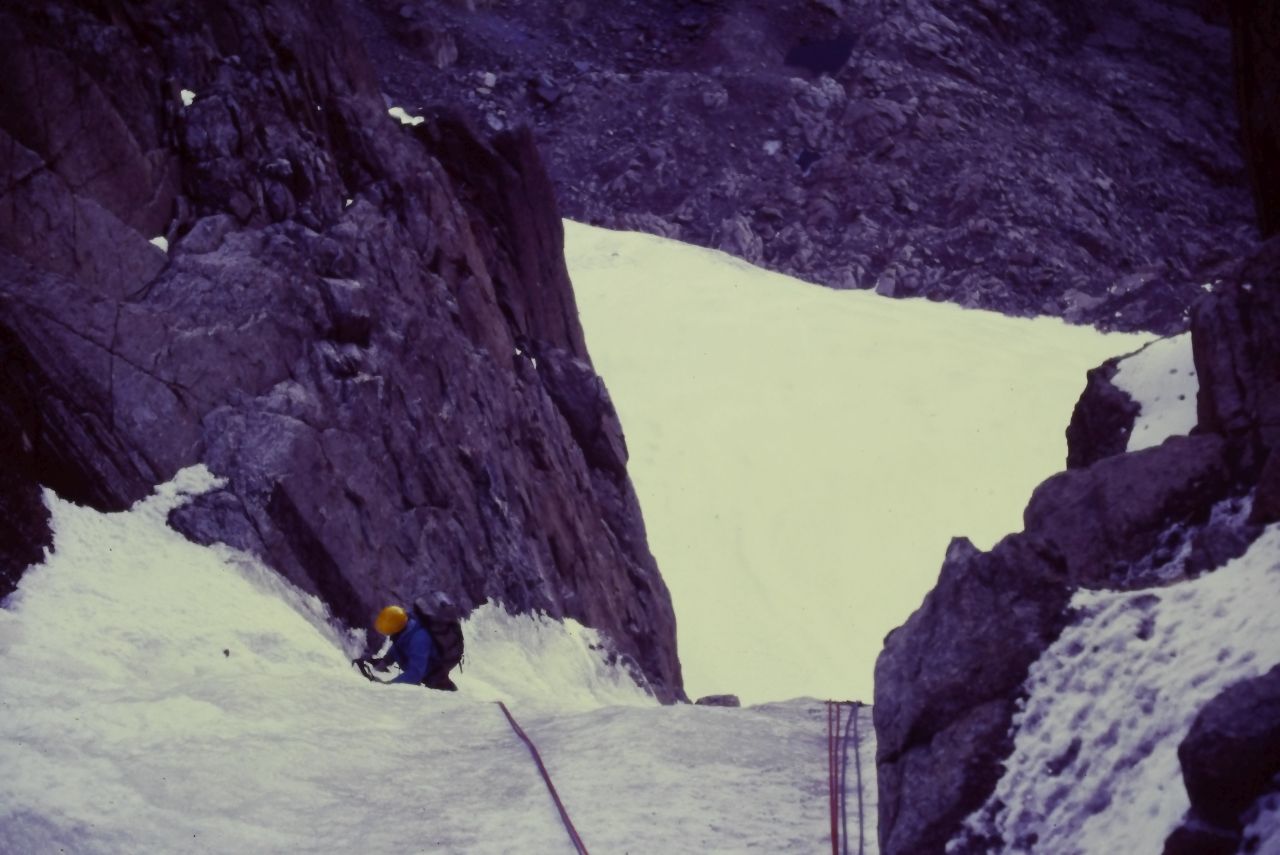
The next section was easier angled and this time when we ran out of rope, I started climbing in tandem with Steve. This stretch was long and tiring! The angle soon reared up again and there followed several classic grade 3 ice pitches with great belay anchors in the rock walls of the gully. But… everywhere we looked, the exposed rock bore the scars of many, many impacts. The tales from the 60s began to feel very real. I began to feel very small, insignificant and vulnerable.
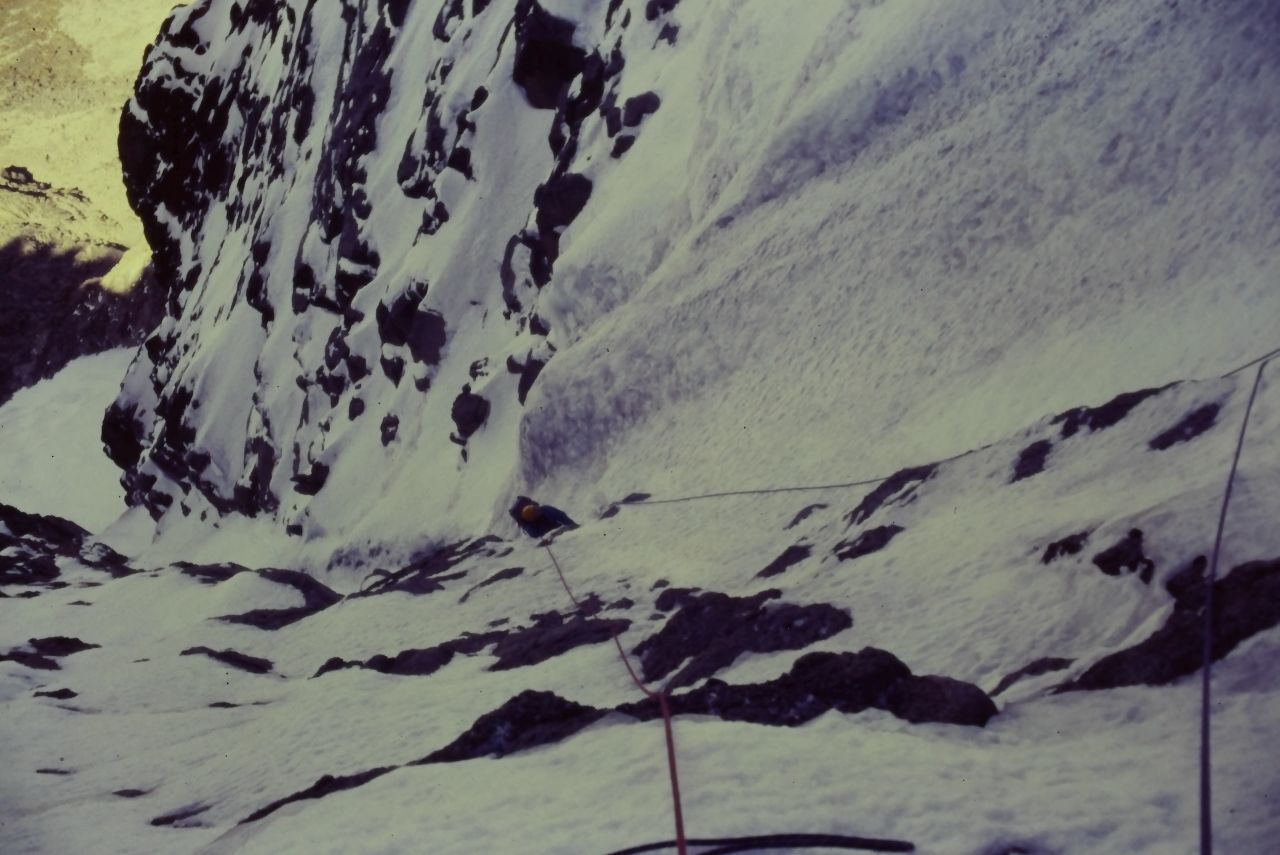
By around 10am we found ourselves in a funnel-like widening of the couloir, beneath the famous headwall section. Steve was belayed in the same place as the classic photo in all the accounts of climbing the Diamond, that we’d read. Looking up, the ice was unusually glassy and clear, suggesting brittleness. However that section looked short with good ice beyond.
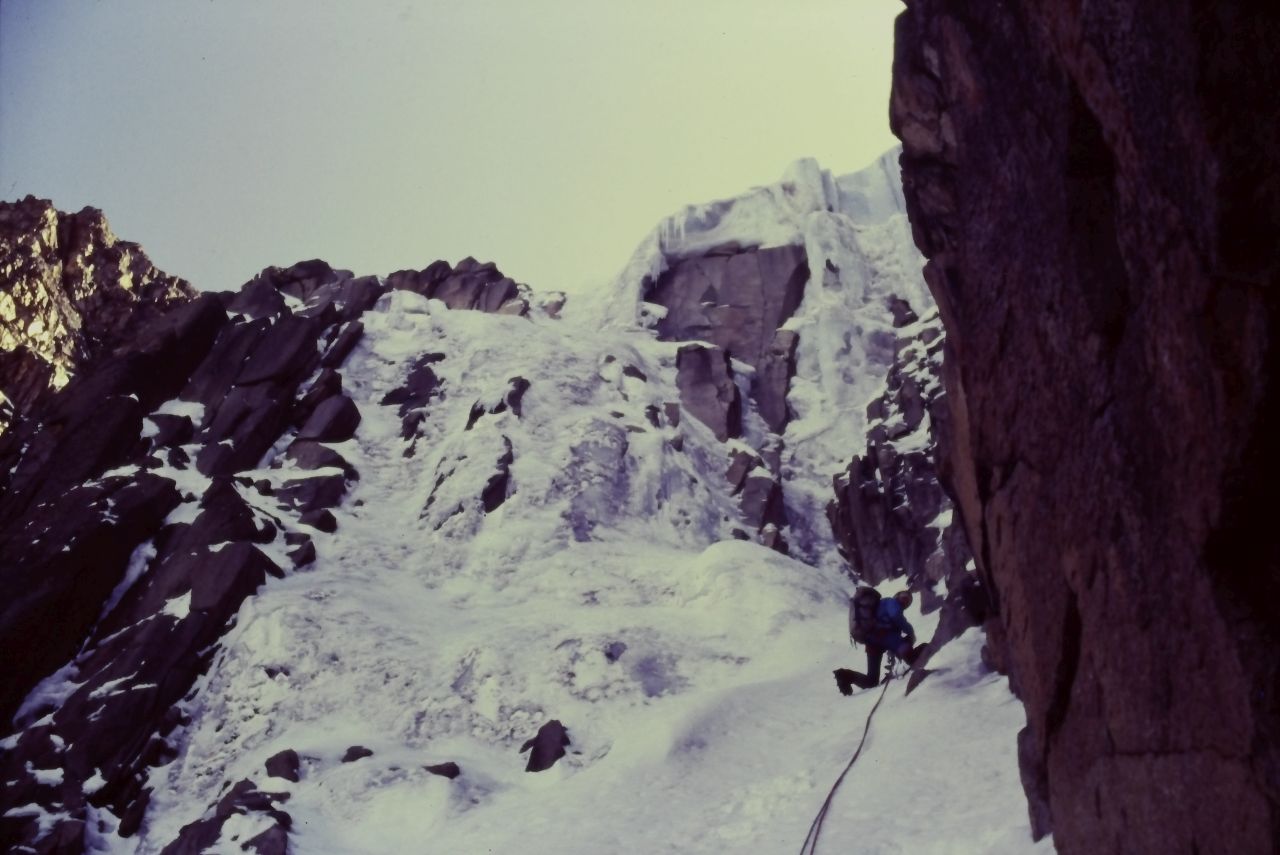
Looking up, the ice was unusually glassy and clear, suggesting brittleness. However that section looked short with good ice beyond. Steve looked at me and his face seemed to say. “Are you sure you are up to this?” He was always the stronger climber than me. But things had been going brilliantly well, the lethargy of the morning had worn off, my frostbite fears seemed a distant flap about nothing, so I said I would carry on.
We were going to try the Headwall Direct: instead of taking the original ramps that led out left and then teetered back right to access the glacier above. Gear swapped, I set off across from the stance and up to what looked like the safest – least steep – line up the imposing headwall. The ice on the headwall was thinner than the guidebook had suggested, so we chose a line somewhat left of where the original direct had gone. That original bit now looked like an insane glassmaker’s evil candelabra of icicles.
I (Don’t) Love The Sound of Breaking Glass
I swung my axe into the beautiful translucent ice. Something sounded wrong… and a crack ran right across the whole 20 foot wide facet I was on. Shit! I waited, expecting unpleasantness. Nothing moved nothing creaked. I told Steve what I had just seen and he tensed the same as me. I said the cliched thing of course. “Watch me!” as I swung the other axe into the same ice facet. Same odd sound, but no fresh cracks. I dropped back down a metre or so and placed a screw in the greyer ice underneath the dodgy sounding section. Back up at the clear section, I took the familiar deep breath and started upwards. Axes and crampons worked in unison. Nothing shifted, but I still didn’t trust what I was hanging from. I placed another screw after 10 feet or so, where there was a blob of the grey ice. Another few metres and another screw went in and finally I was clear of the “breaking glass” section
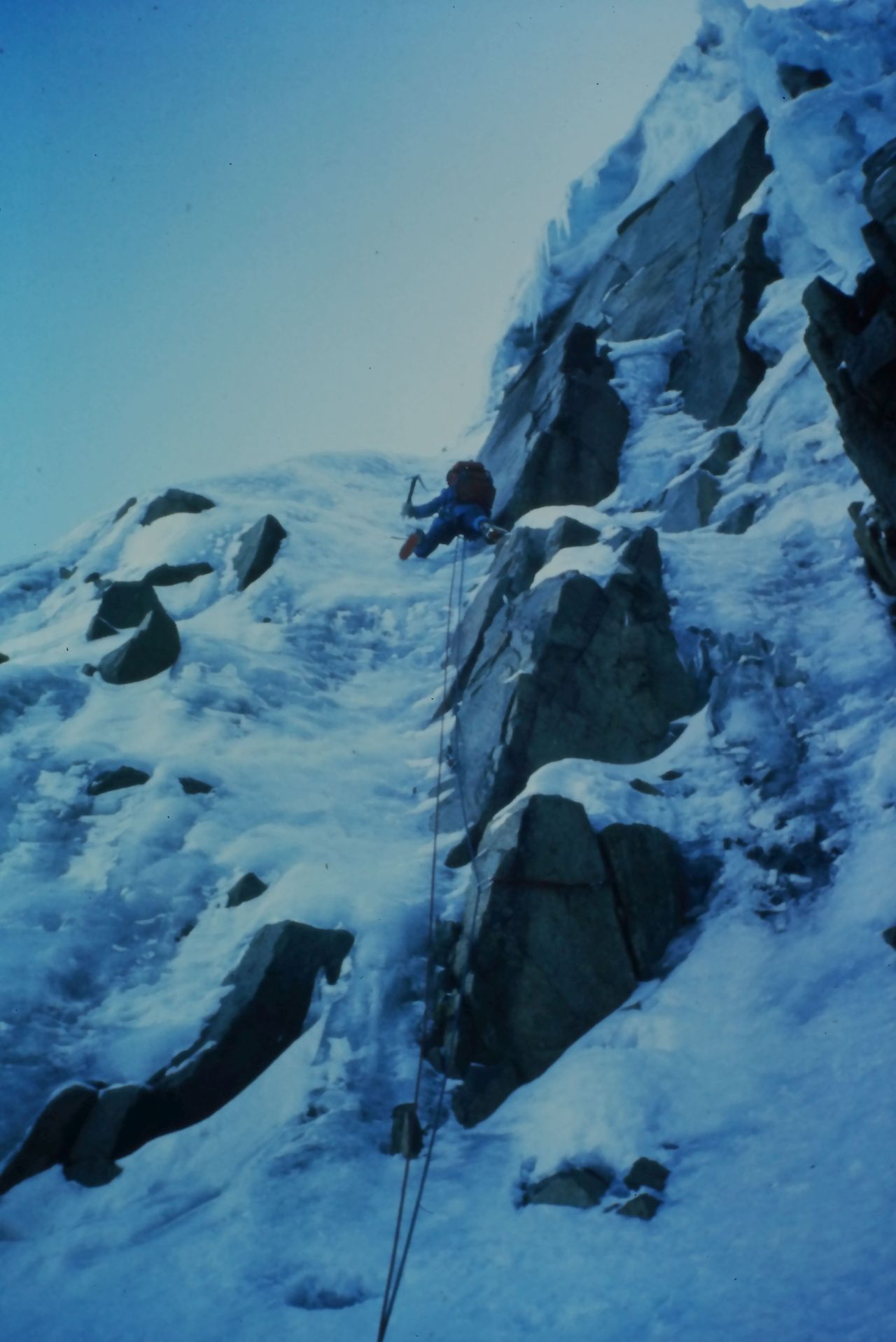
I was also pretty short of screws now. I carried on for about 60 feet up the impressively steep wall getting rapidly more tired as the tension of the bottom section caught up with me. The angle eased slightly for the next 40 feet and then, protruding from the ice, a chunk of rock gave me a solid foothold to rest my screaming calves and let my arms relax a bit. I got a screw into the ice and clipped it.
If memory serves me right, I was probably sixty or seventy feet above my last gear! Looking down all I can see is shiny grey ice, dropping away for eight big pitches and Steve’s bemused face.
Gathering myself for one last effort, I traversed up and leftwards towards a rock outcropping. Thankfully there were good slots for nuts and stompable snow that let me put my feet flat at last.
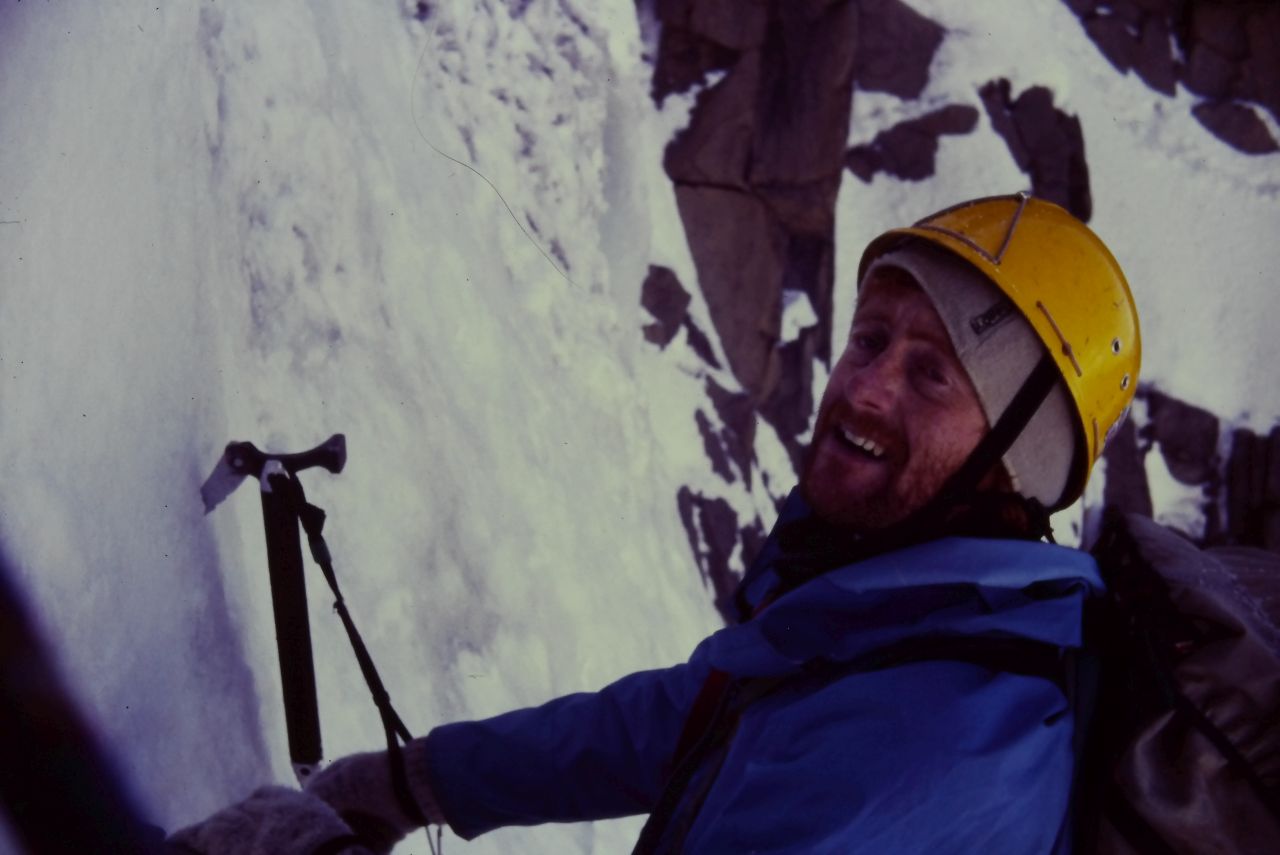
When Steve got up to me, we mumbled some nonsense about ice cracking as we swapped over the gear. It looked like this ninth pitch was going to be a bit of a pushover as it wasn’t as steep as what had just come before.
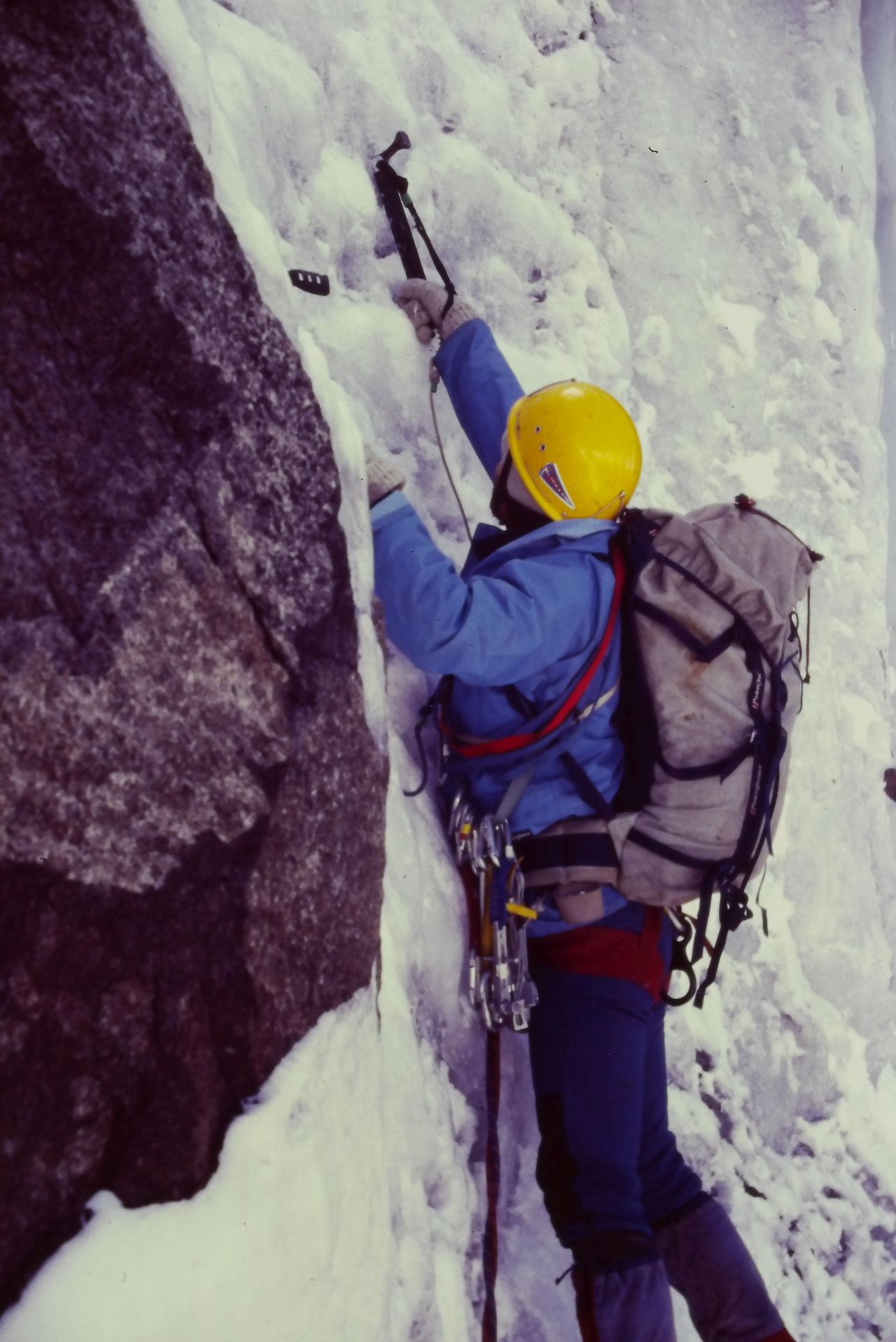
Oh dear me – how wrong we can be. As Steve set off up it, it was instantly obvious we’d run into another flavour of tropical ice, This stuff had a real cruddy, brittle surface layer and was brick hard underneath. It was probably the most insecure pitch of the whole climb and a lot steeper than first impressions suggested.
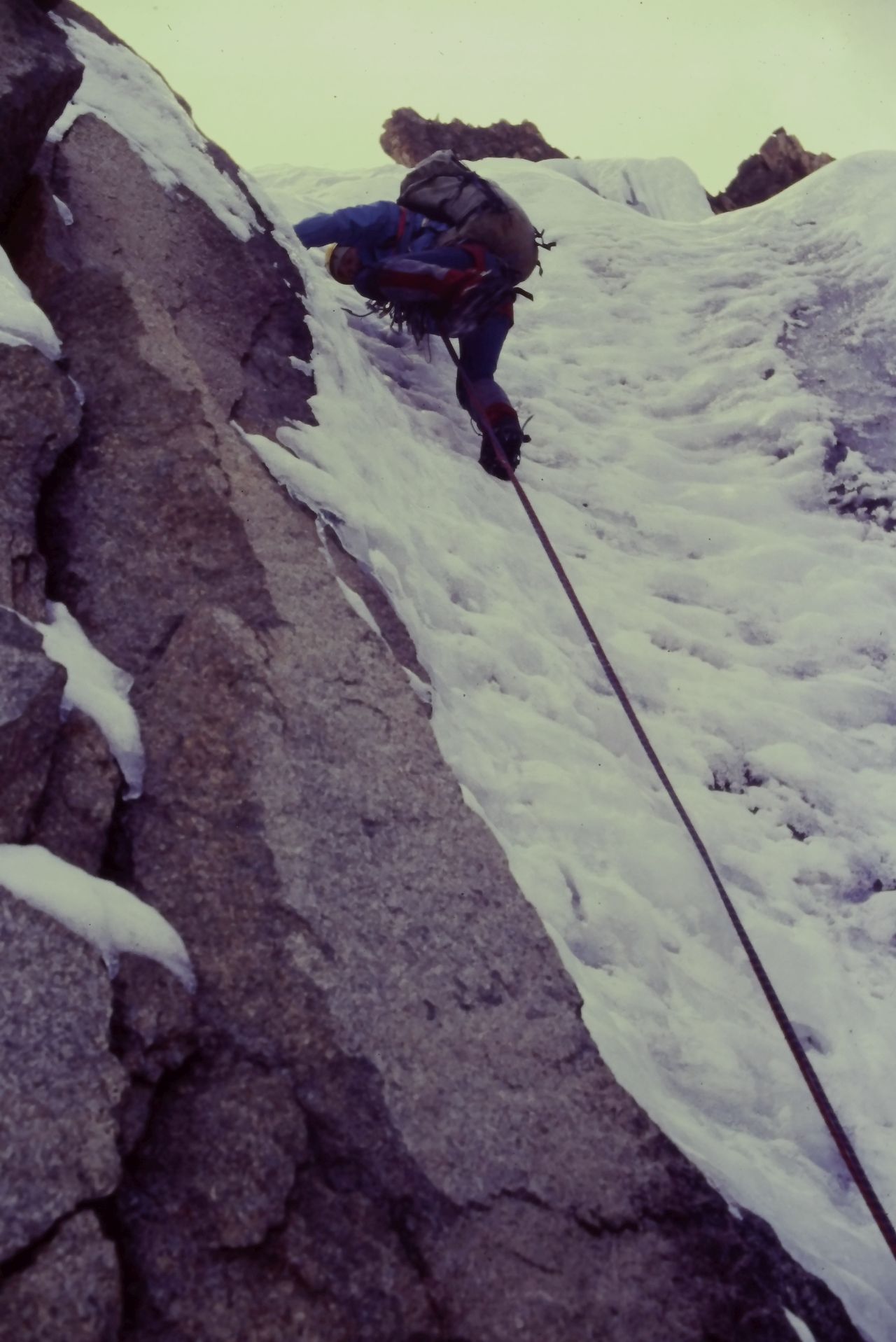
I led off from Steve’s stance – secured by a couple of poor ice screws. The glacier seemed even more unfriendly than a few days previously, so I headed directly for some rocks poking out, a shortish pitch to some secure anchorage. Finally we felt that we’d genuinely “done the Diamond”. Feeling fairly safe and secure at last the tension dissipated and with it, any sense of strength or “manliness”. The next three pitches to the Gate of the Mists were a real grind. Despite the tiredness we were surprised to find it was only just getting on for 1 in the afternoon. We rested for a half hour or so, until we began to feel the chill in the air.
The Real Summit
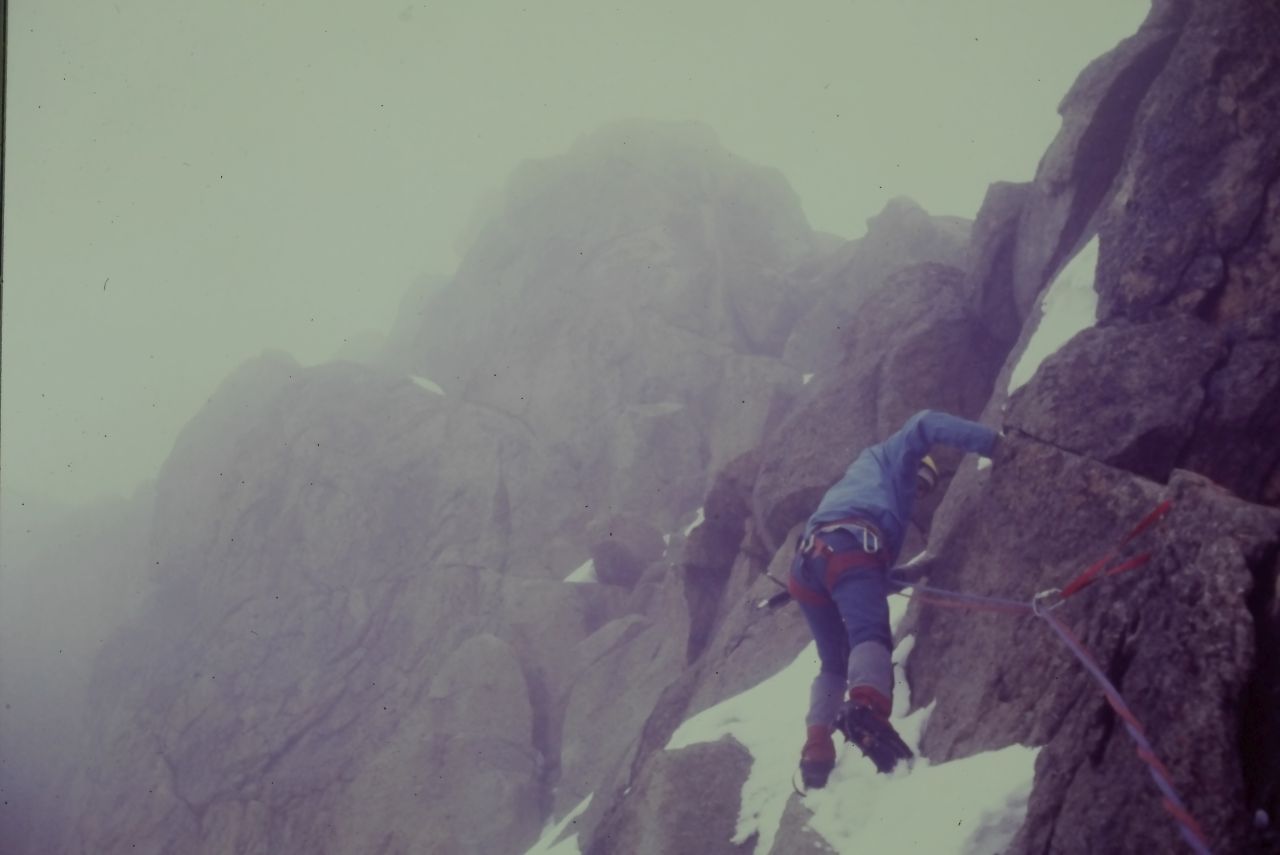
Batiaan, the higher of the twin peaks by eleven metres, awaited. We dumped the bags in the Gate and set off much lighter on our feet. A surprisingly long drawn out 5 pitch scramble up the east ridge of the peak, now in broken cloud, saw us on the summit with not quite such a clear view as we’d had a few hundred feet away on its twin.
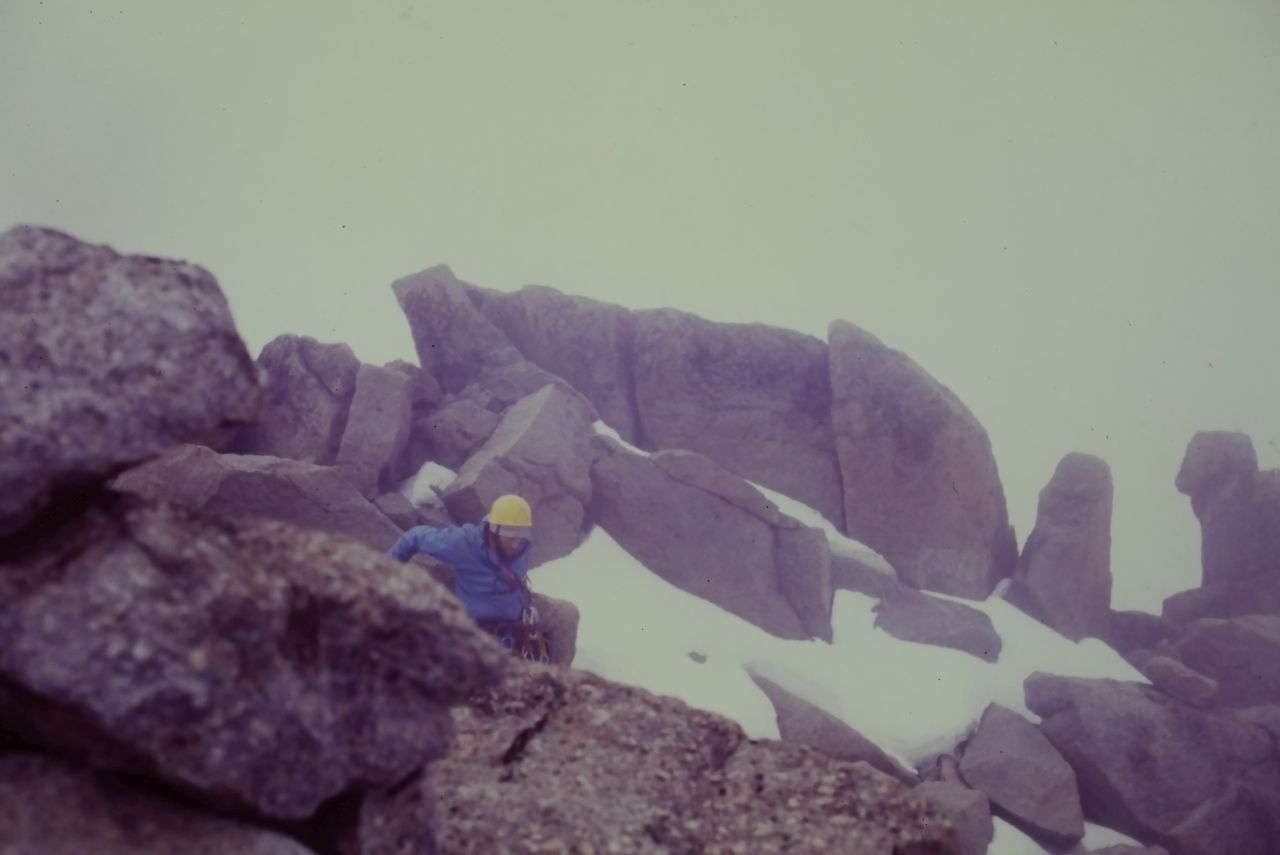
It was a satisfying but somehow anticlimactic moment, to have managed to bag Kenya’s two most classic ice climbs within a couple of days of each other.
Rather than scrambling back the way we’d come – to the Gate, Steve proposed abbing down off the summit into the South face and scrambling back lower down. It worked , but was possibly a little more mixed and spicey than Steve had anticipated. It presented a long pitch of mixed ground before we got back onto the actual scrambling ground.
Picking up the bags again set off every single “weary sensor” in my body. It was an even slower flog back up to the summit of Nelion again. Including the pitch back out of the Gate, we’d climbed twenty, mostly long, pitches before we saw our shelter for the night.
Club Coffin
Bruce and Colin had arrived on top of Nelion just before us and there was a lot of chuffed banter about the day’s adventures. Bruce had had a slightly more exciting day than the rest of us having taken a short fall at some point in their proceedings. No harm done luckily. That evening the chilli con carne tasted extra spicy.
Unfortunately for Colin – when he pulled out his sleeping bag it was soaked. One of his water bottles had dribbled. As we sat outside, after eating, a light aircraft came by and buzzed the summit area several times. Once again in the distance we could see massive cumulonimbus clouds to the west and north. Way out over Uganda – someone was getting treated to a truly spectacular set of thunderstorms. Four up in Ian Howell’s shelter was very cosy indeed that night and even though the windows faced away from the storms we were very aware of the lightning as we settled down to sleep.
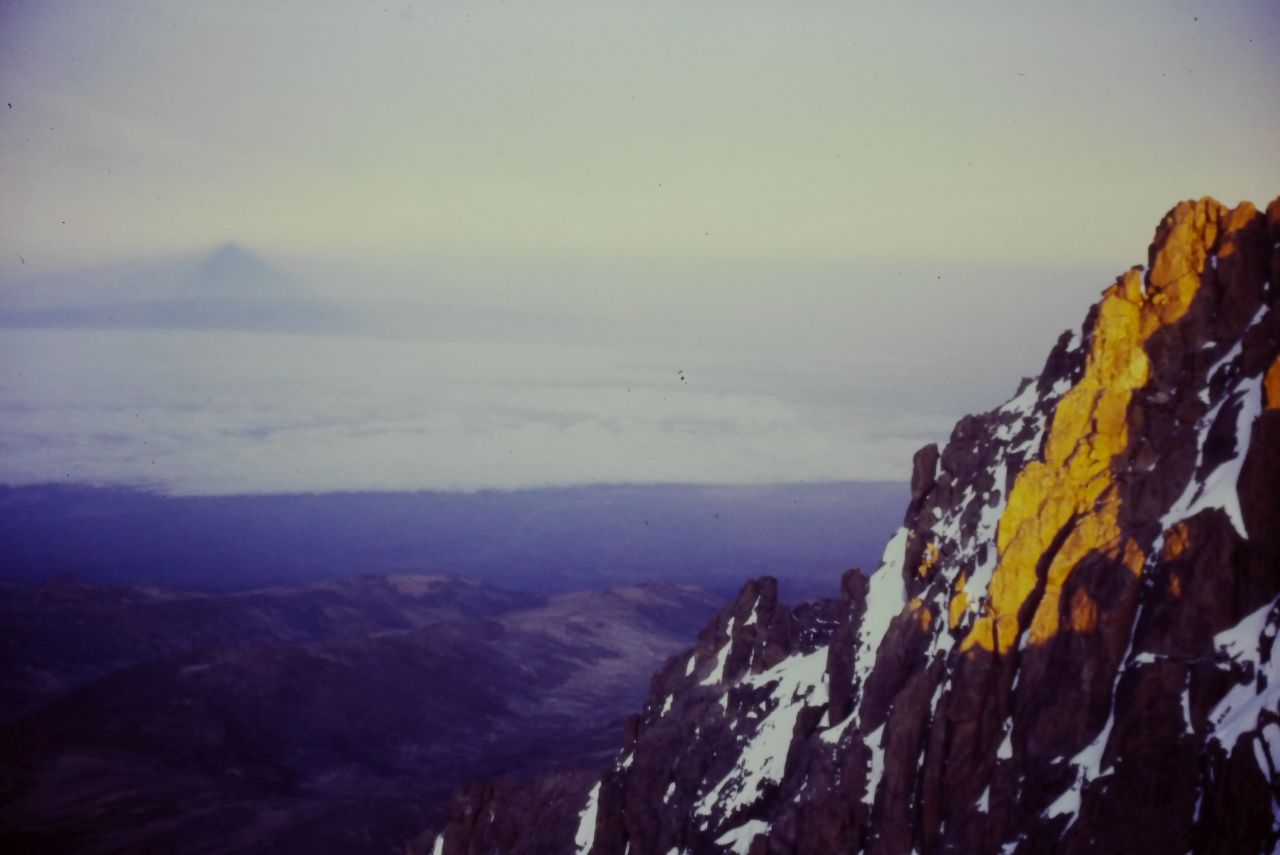
It was a late start next morning. The Cambridge lads set off to find our tracks to get up on top of Batiaan as well. Steve and myself eventually got moving around 9. The descent route was now familiar and 10 abseils with a couple of climb across pitches saw us back on the Lewis at around half eleven. We even bumped into a couple of Scottish lads following on our friends’ route. It was a very rubber legged return to our tent. Collapsing we dossed and listen to tapes, waiting for the other lads to return safely. The afternoon weather broke down to hail showers for the first time in 3 days. Going a day early proved to have been well worth it.
Rest And Rock
A day of rest and a genteel walk down to Mackinders Camp for some more craic and a better look at the lobelia forest was needed. On the way back up the hill we passed the ranger station and had an interesting half hour’s conversation with him. He was mystified why us “rich” Europeans would like dangerous situations like climbing, but was glad it gave him a way to earn a living.
After a slightly dodgy scramble up beside a waterfall we rolled back into our camp . I was surprisingly puffed, thinking my acclimatisation hadn’t been as complete as I thought (completely failing to take into account the past five big days!).
Steve had spotted a very tasty rock climb on the north side of the mountain. The west – or Window – ridge of Point Peter. It was a fairly long trek round to the start of the route and we anticipated being away 2 or three days. Once packed up – with gear rearranged to an alpine rock setup, we set off. Two Tarns Hut came and went followed by a col from where we nipped up a top called Arthur’s Seat. This viewpoint gave a very clear line of sight to the huge NW face of Point Piggot. Our conclusion was – horrible! But there were a few lines that looked like they might be ok.
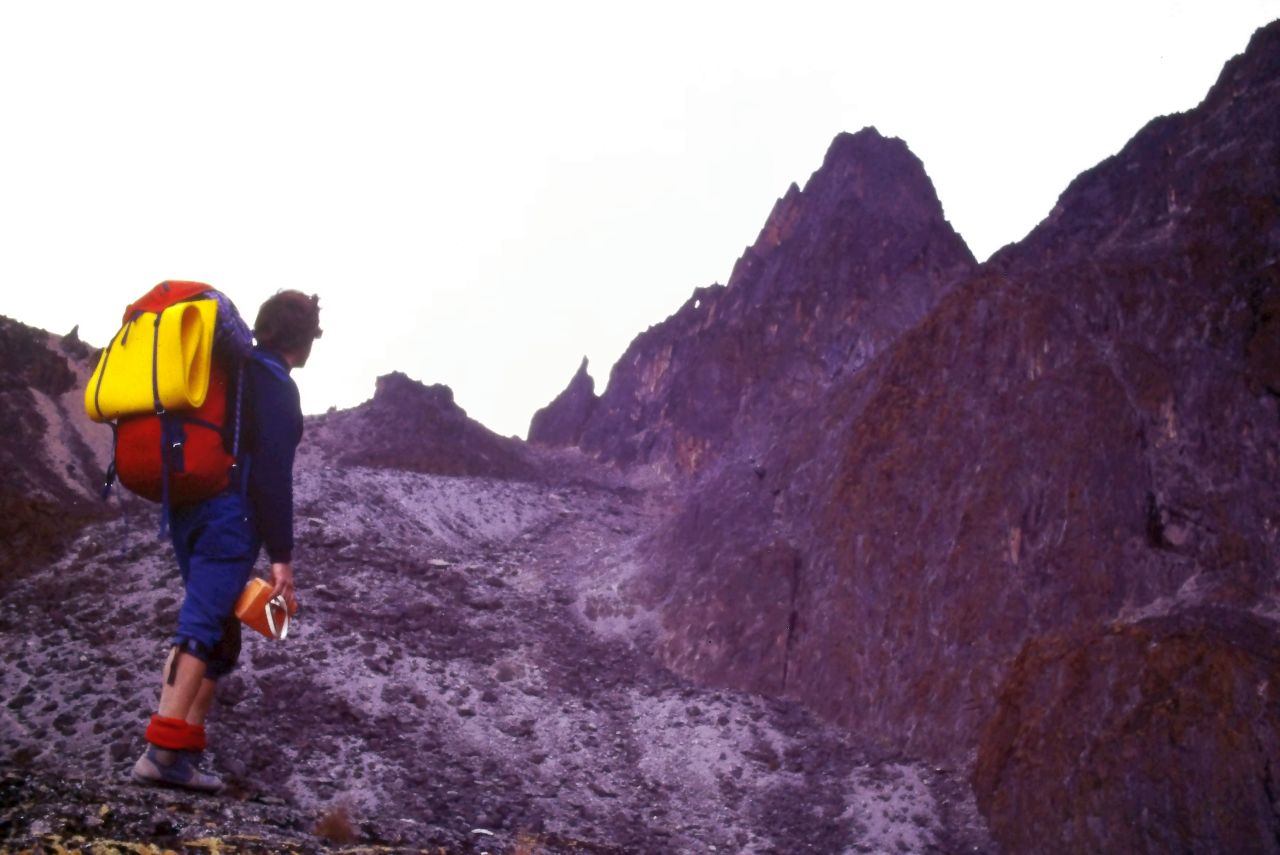
On we trekked and eventually ended up between Hausberg and Oblong Tarns. We decided to bivvy there, in this rather beautiful setting. We had a clear view of how the window ridge got its name. This unbelievably narrow fin of rock with sheer drops either side was a reminder of the geological impermanence of high steep places. At some point a huge volume of rock had fallen out of its structure leaving a huge window through to skies the other side. Over Turkey Marengo(?) we sat and watched the sun set before settling down on the mossy ground.
Leopard Mice and a Sleepless Night
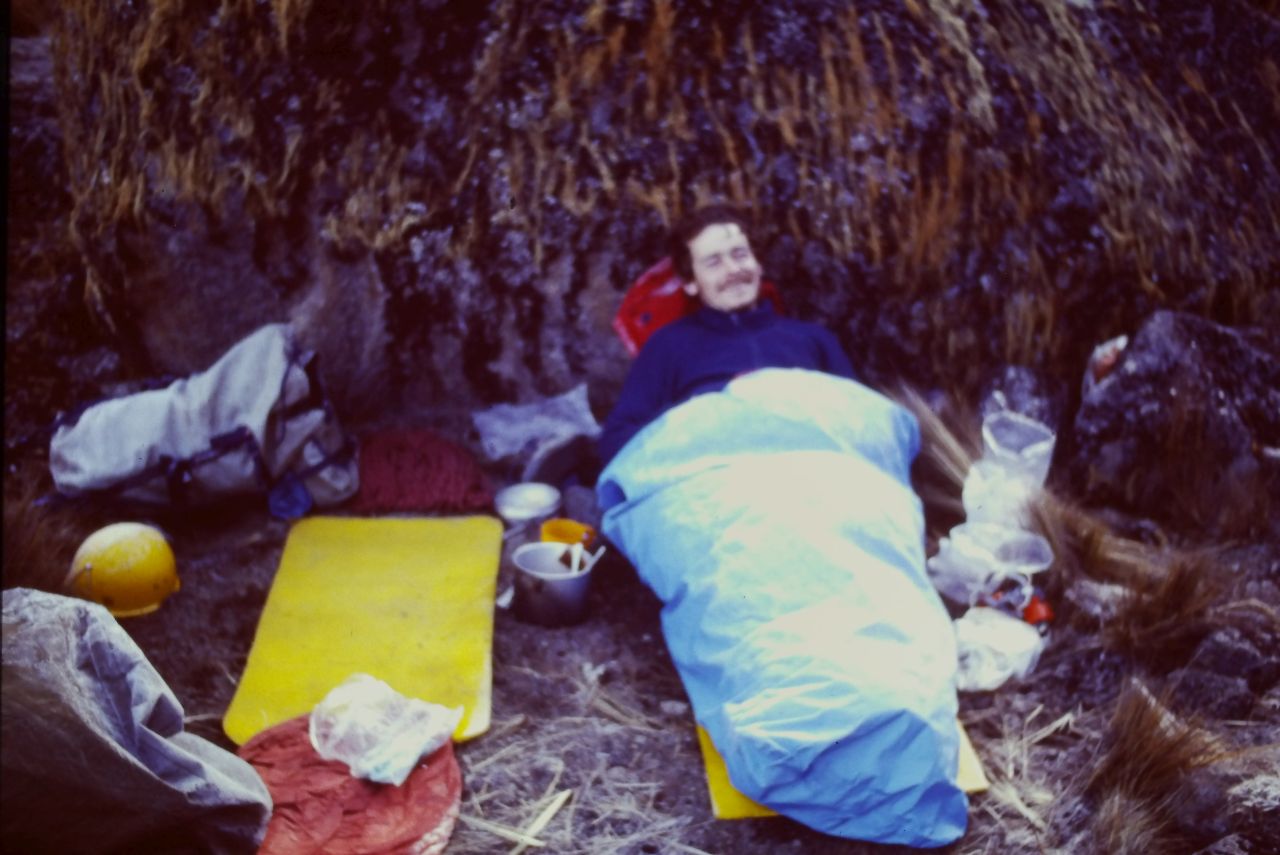
Sleep didn’t come easily. The rustling of mice and a sudden irrational terror of leopards stole over me. Once again I was crapping myself. Sleep must have eventually taken hold because I eventually woke up to find my bivvy bag completely coated in frost, despite being toasty warm in my sleeping bag!
An Immaculate Line
Once we’d eaten, drunk and dried our pits out, we set off for the base of the first rock climb of the trip. It started easily enough with (if memory serves me right) a couple of fairly easy pitches which brought us to the base of a steep groove. A beautiful rock feature but challenging for a couple of wide boys pretending to be mountaineers.
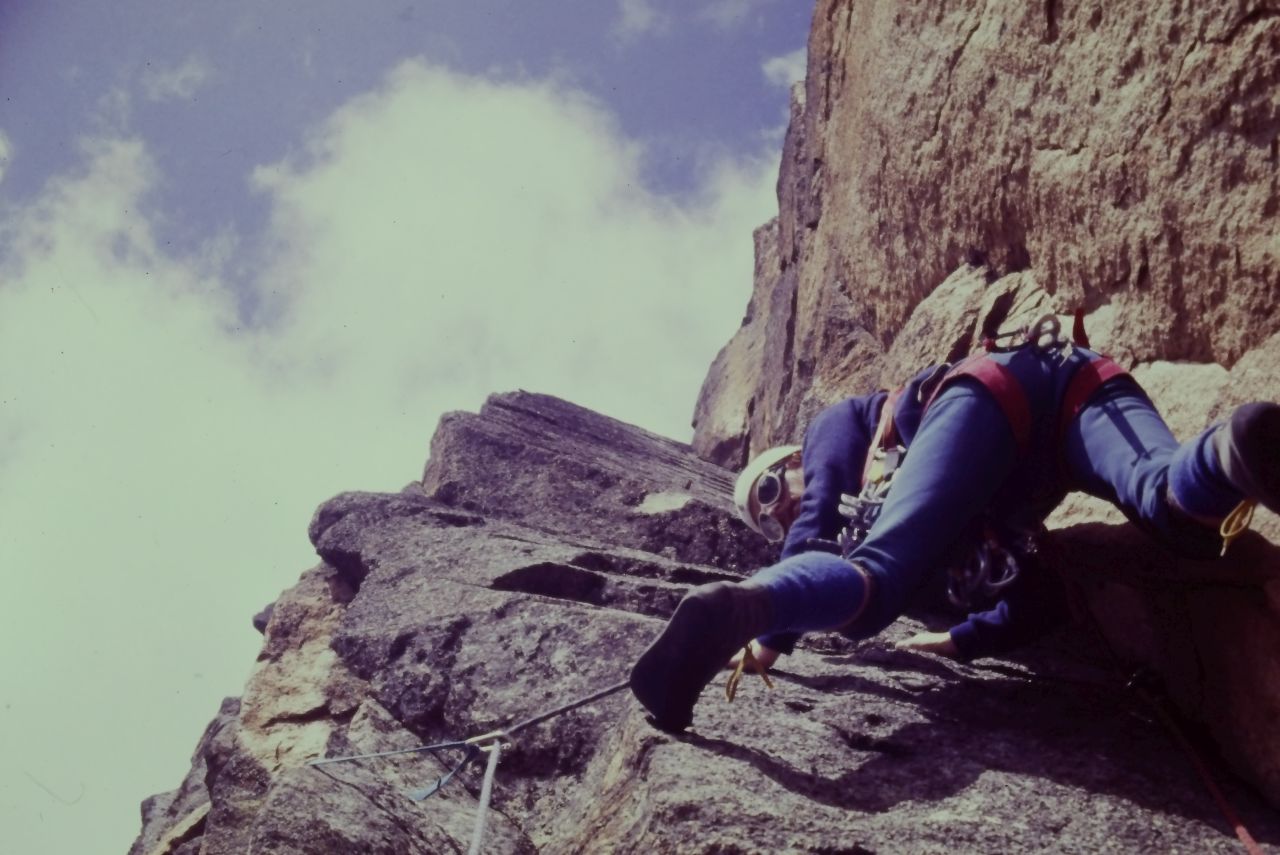
It was Steve’s lead fortunately and he tackled it with the ease and the smooth movement I’d grown used to over the past couple of years. In a surprisingly short time he was up the first stretch.
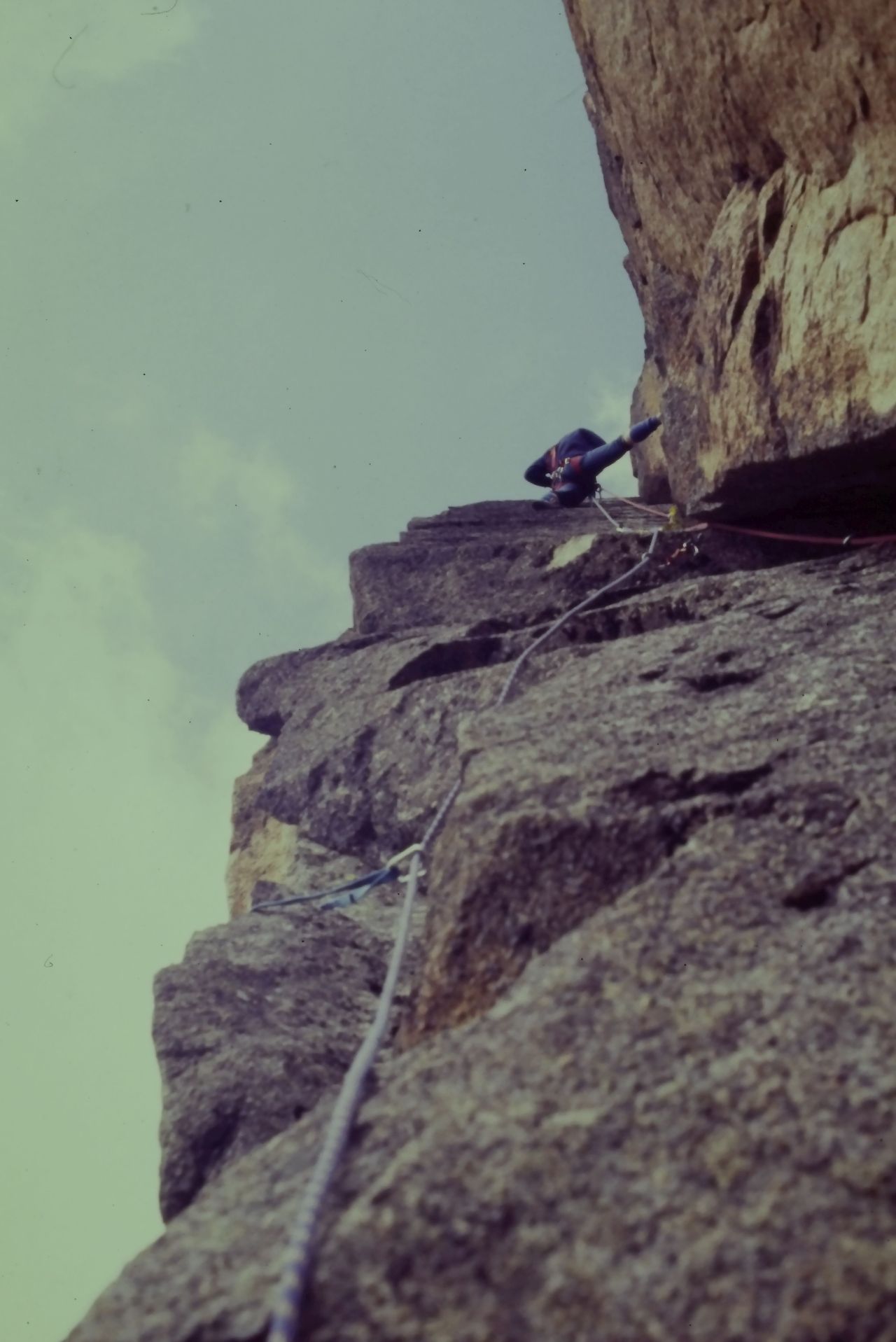
I followed with difficulty. I was probably at my absolute peak of fitness and strength just then and I would guess (lacking a guidebook these days) that it would probably be the pitch needing aid. I guess (with the passing of 43 years and a healthy dose of rose tinted spectacles) it went free at about E2 / 5c-ish sort of standard. Those numbers don’t matter much but I remember an absolutely stunning pitch of intricate smearing and bridging.
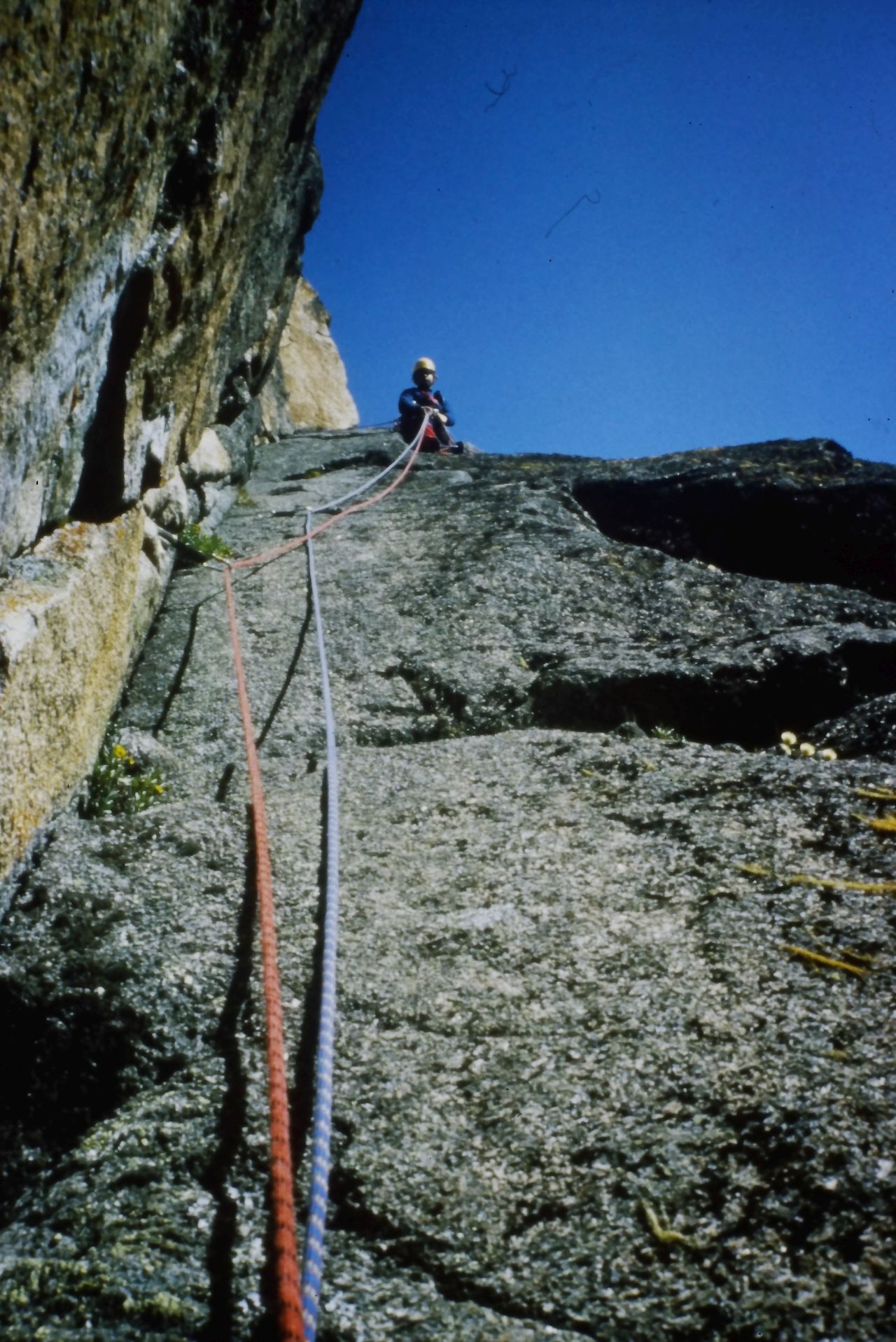
My diary doesn’t have much detail of the rest of the route and I don’t clearly remember many details other than absorbing corners and slabs that saw us on the summit of Peter a mere two and a half hours later, for what was supposedly a ¾ day route.
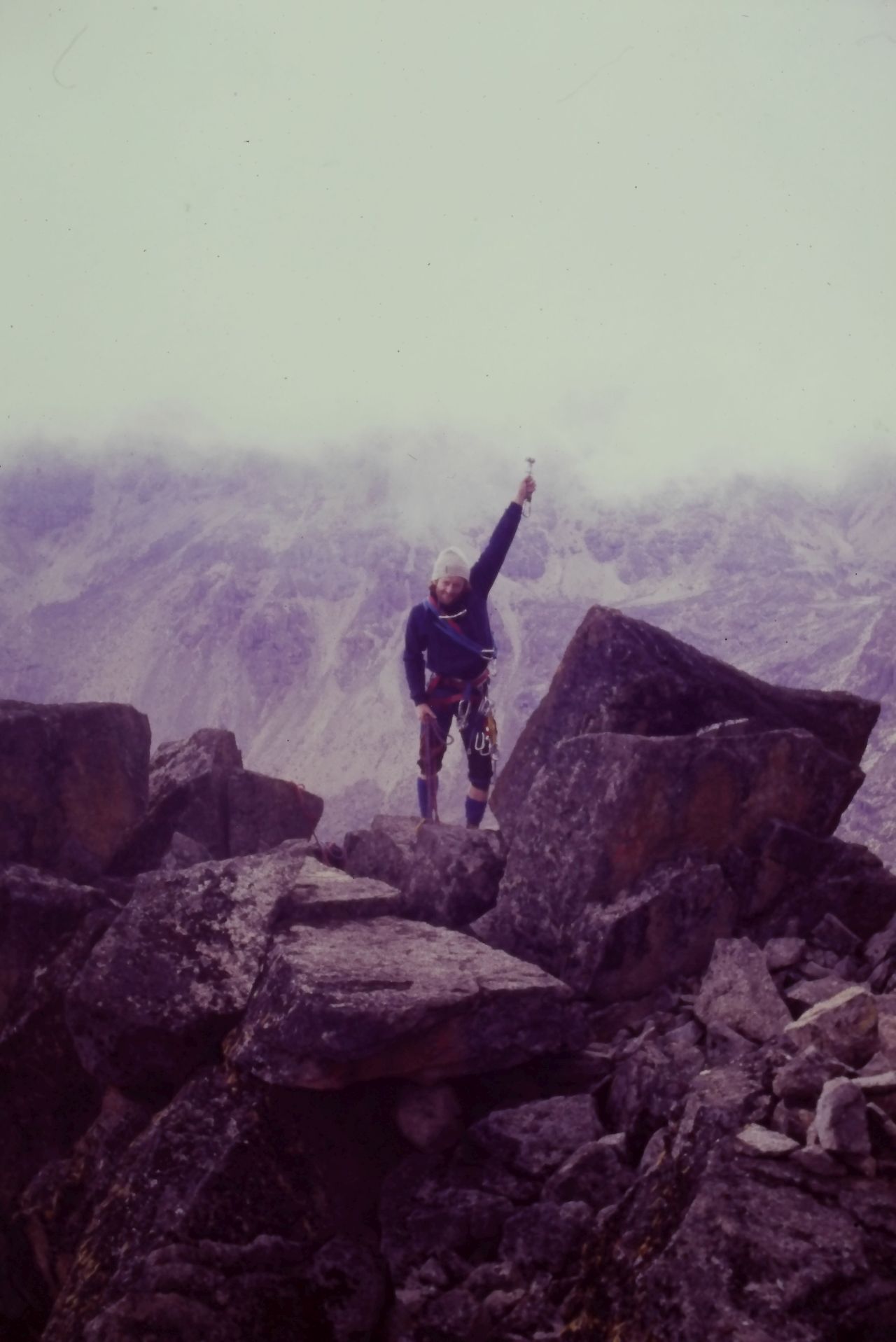
I suspect it was a first free ascent as the KMC records didn’t mention anyone else doing it free when we checked. The descent went un-memorably and we were soon down at the bivvy site to pick up the rest of our kit. We took a slightly different route back to base camp, via Two tarns. The one we passed was absolutely beautiful!
The following day we were straight out onto Midget Peak just above our base camp and had an interesting cock up of a climb. We set off up Neckpad and ended up following bits of two other routes (we thought) after completely losing the line. So much for our growing super-alpine confidence. 😉
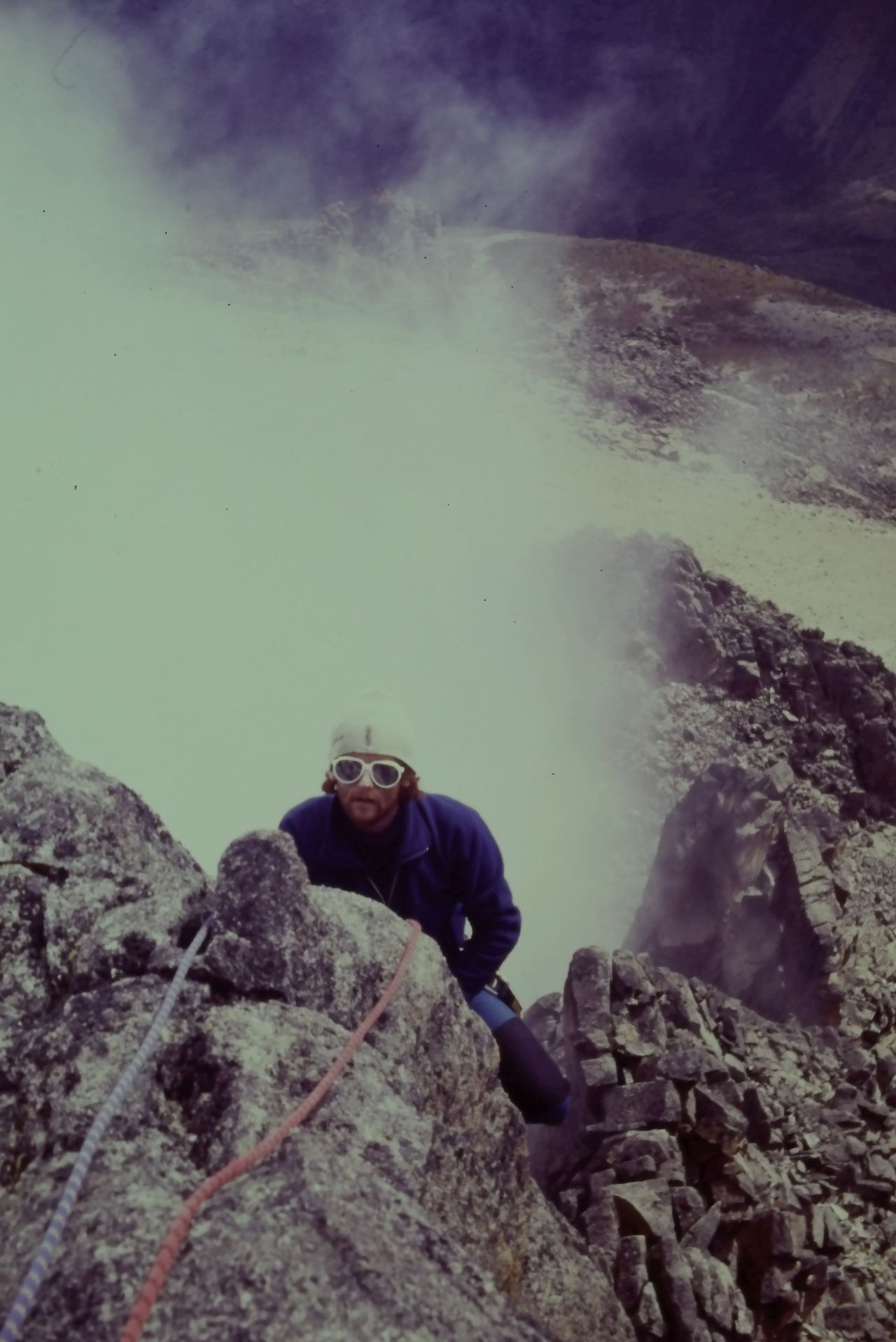
Behind Midget sat Point John. We had designs on its south ridge, as a warm up for our real objective. But, when we woke up on the morning of the 10th, I think we were both completely knackered so we called it a rest day and dossed at the tents. From our supine positions we watched other parties high up on the south face ice routes we had just completed. At one point an American guy came by to shoot the breeze.
Last Words Go To The Weather
Lurking almost sub consciously beneath our resting was the thought of the Scott Braithwaite route. This is the massive rock pillar on the north side of Batiaan which was another grade harder than our Window Ridge outing. Alas it wasn’t to be. After the trek round to the Kami Hut, at my slow pace, Steve had already disappeared up for a cloud shrouded recce up the Krapf Glacier in the mist, looking for a safe way up the steep snout the following morning. Steve emerged out of the mist a bit wide eyed due to the stonefall pinging out of the North Gate. Unfortunately temperatures had risen in the previous couple of days and the glaciers hadn’t frozen overnight for a couple of days. Great for the climbing… but not so great for getting to the climbs. We came to the conclusion that if it froze overnight, the approach would be safe enough to risk.
The Kindness and Craic of Strangers
The highlights of the evening in the Kami Hut were the “conversation” with the Spanish lads who didn’t speak English (one of whom had had broken toes due to falling rocks) and us two who spoke no Spanish. The second highlight was a real surprise – the extra meal dished out by Johnson, the Spanish lads’ porter: fried onions, maize and beans with a dash of chilli. It turned out Johnson was a 22 year old “schoolboy”, working his nuts off to raise funds to finish his primary school education. Outside it had begun to snow. As we tried to sleep, it became obvious that the route wasn’t going to be on the following day. To add to the distractions to sleep… the sound of mice rattling around in the panelling of the hut meant little was had.
The following morning the snow had mostly melted but it was still warm and cloud obscured the north face of Batiaan, so back to the base camp tents it was. After our early successes, the time on Mount Kenya was winding down to a pretty anticlimactic finish. Bad weather aborted two other starts and after a particularly tedious day in the tent staying out of the hail and sleet. We had had enough. Thoughts of decent grub seemed to override everything else.
Downward Bound
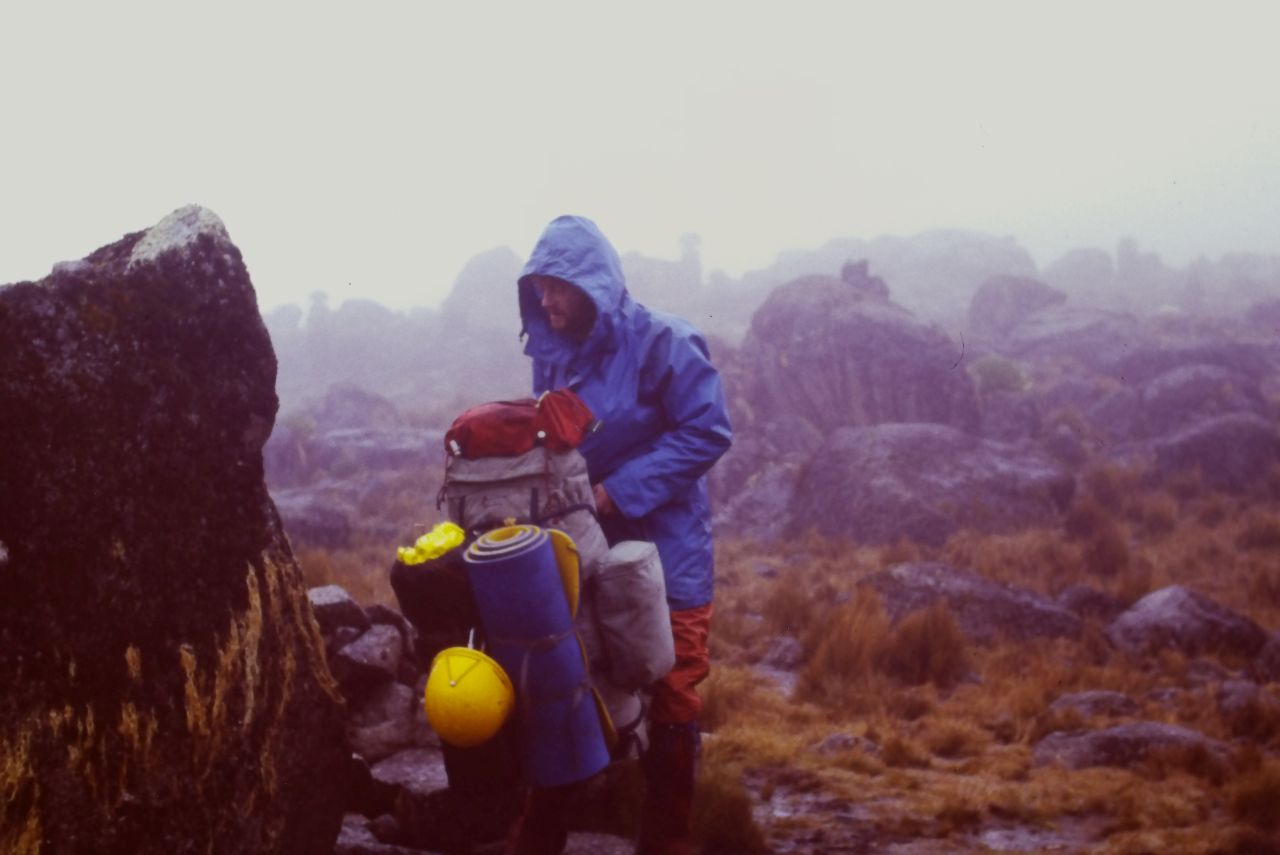
We had no porters for the descent so like my Peru experience the year before – everything was loaded onto our backs fronts and the food bin between us. As we passed the ranger station we were relieved of the bin in a trade for a brew.
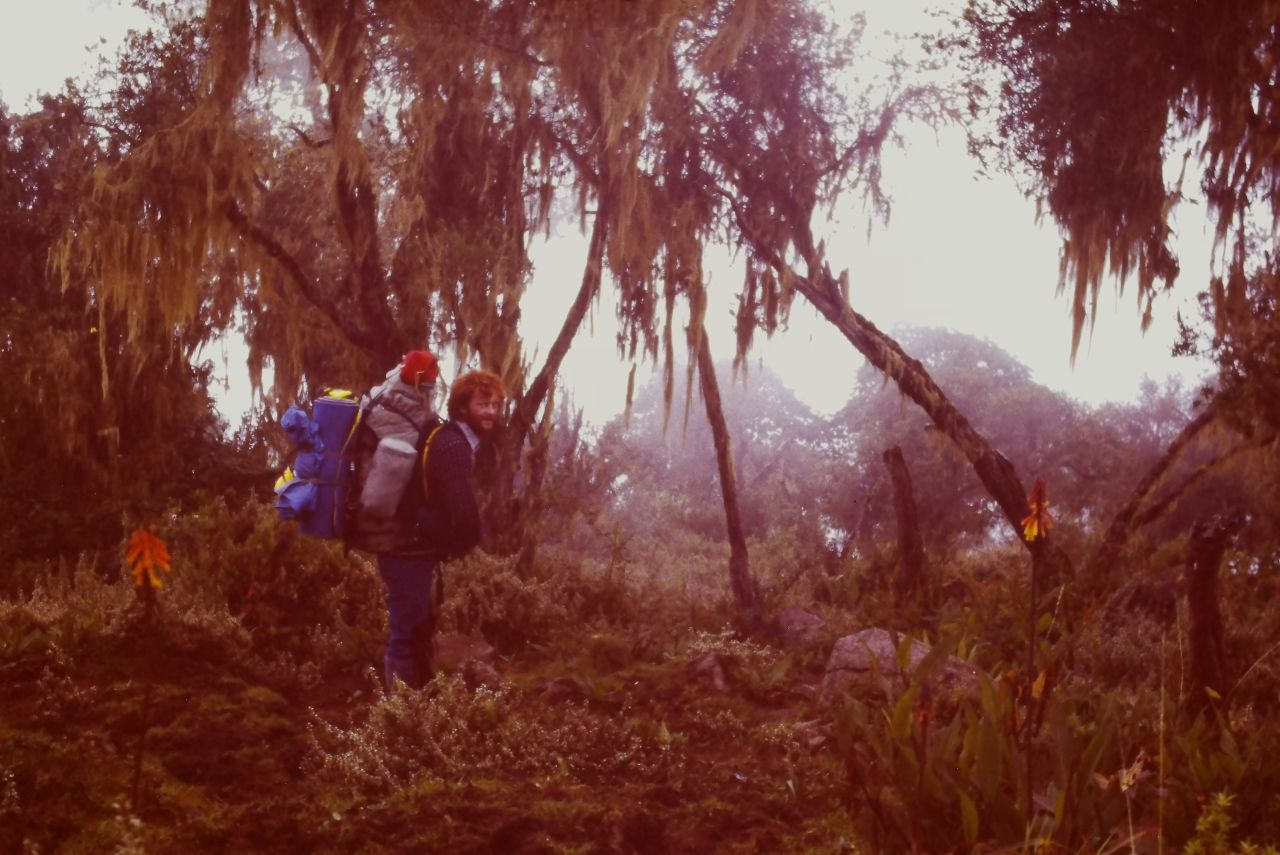
Three and a half hours later we stumbled into the met clearing and set about trying to organise a lift down to the lodge. Eventually we blagged a ride down, crammed into the back of a little Suzuki jeep driven by a German couple. Two hours of low cost torture took us back to Naro Moru Lodge, a great meal and some beers after a fortnight without alcohol.
And Now For the Holibobs
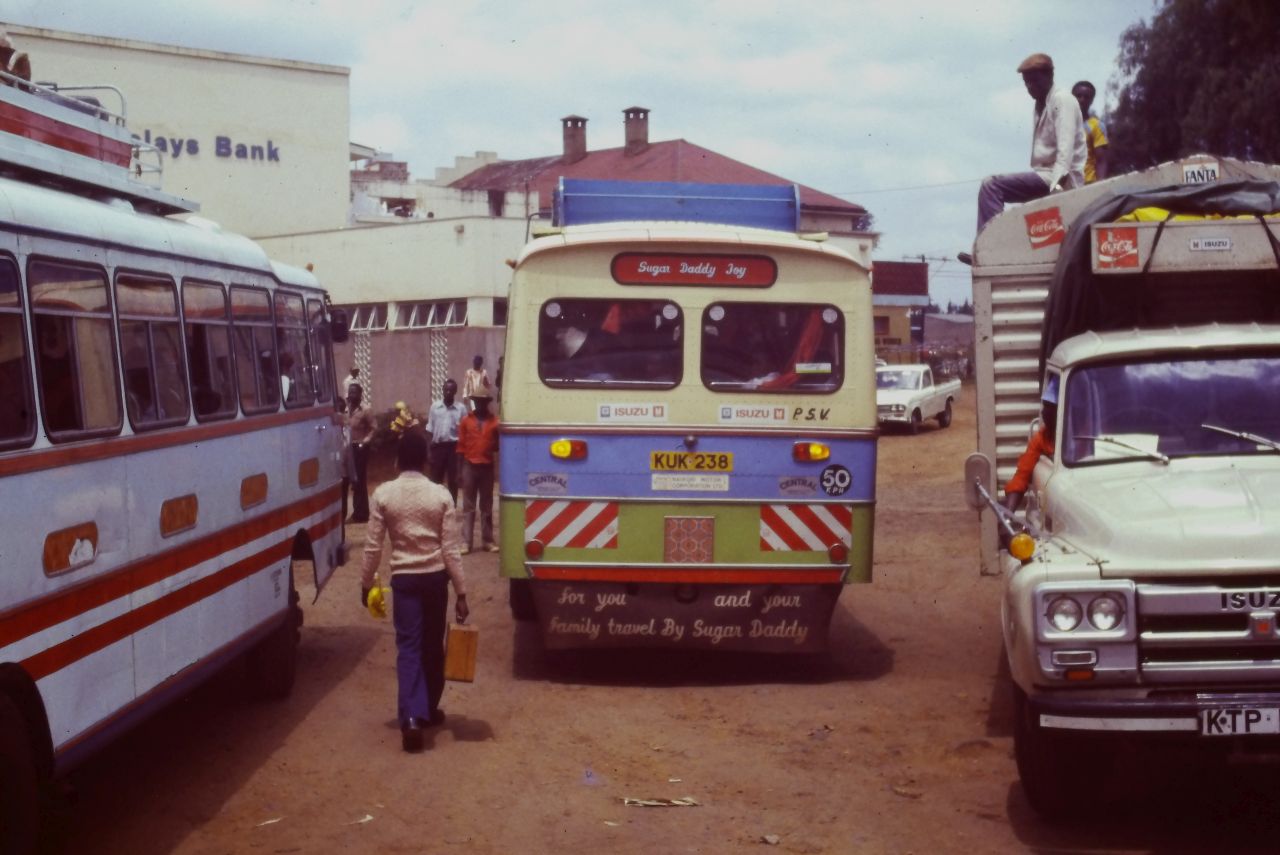
The adventure didn’t stop there. Once we were back to Nairobi in the next torture chamber of the “country bus”, we air freighted our heavy kit back to the UK and hopped on a night train to see Mombasa and the Indian Ocean: a total contrast to our time on the mountain.
Then Rod and Bar invited us to join them on their holiday safari… and that is a whole other tale: way up into the Rift Valley, acacia thorn punctures miles from civilisation, angry park guards with guns, lions closing in for a quick snack of white man, a charging bull elephant and my “giant pig” moment (who knew hippos were pink?). I still had a lot to learn! Then there were the serried ranks of more pinkness: flamingos crammed into Lake Nakuru!
Thanks to Steve for the idea and his sure eye for a line. Enormous thanks to Rod and Bar Bennett who were so gracious with their hospitality and kindness.